Toxic pollutants released during gas flaring are endangering millions more people than previously feared, a BBC investigation suggests.
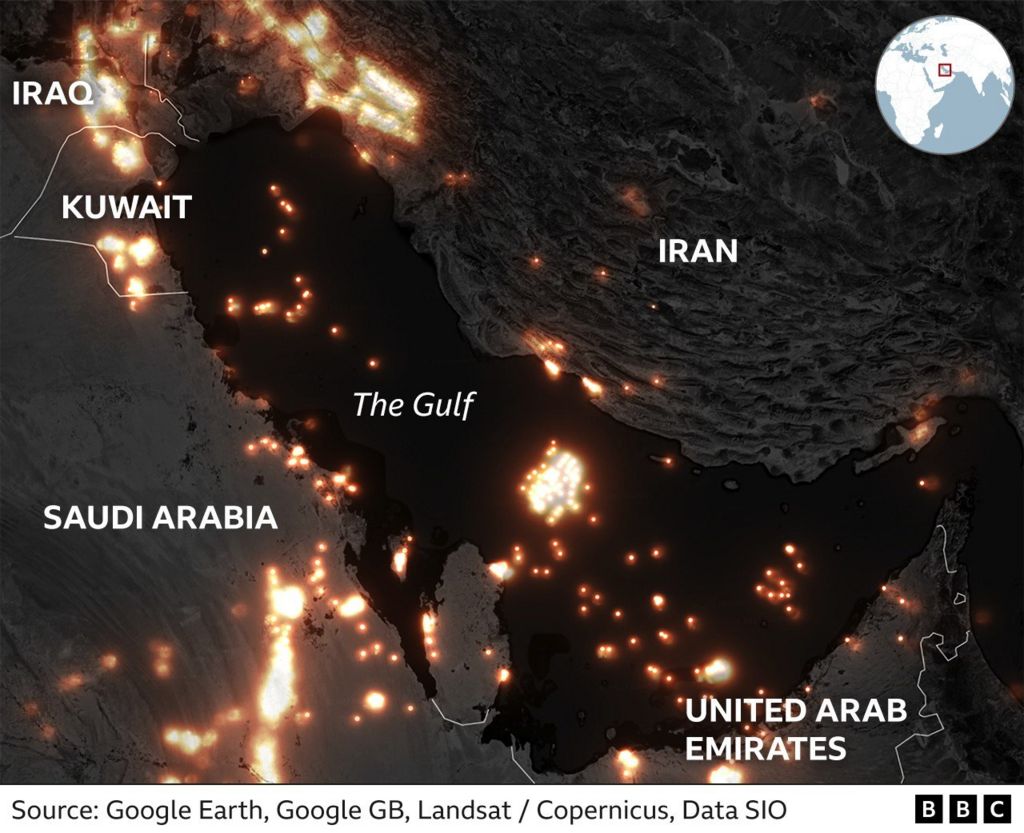
Flaring – the burning of waste gas during oil drilling – is taking place across the Gulf, including by COP28 hosts the United Arab Emirates.
New research suggests pollution is spreading hundreds of miles, worsening air quality across the entire region.
It comes as the UAE hosts the UN’s COP28 climate summit on Thursday.
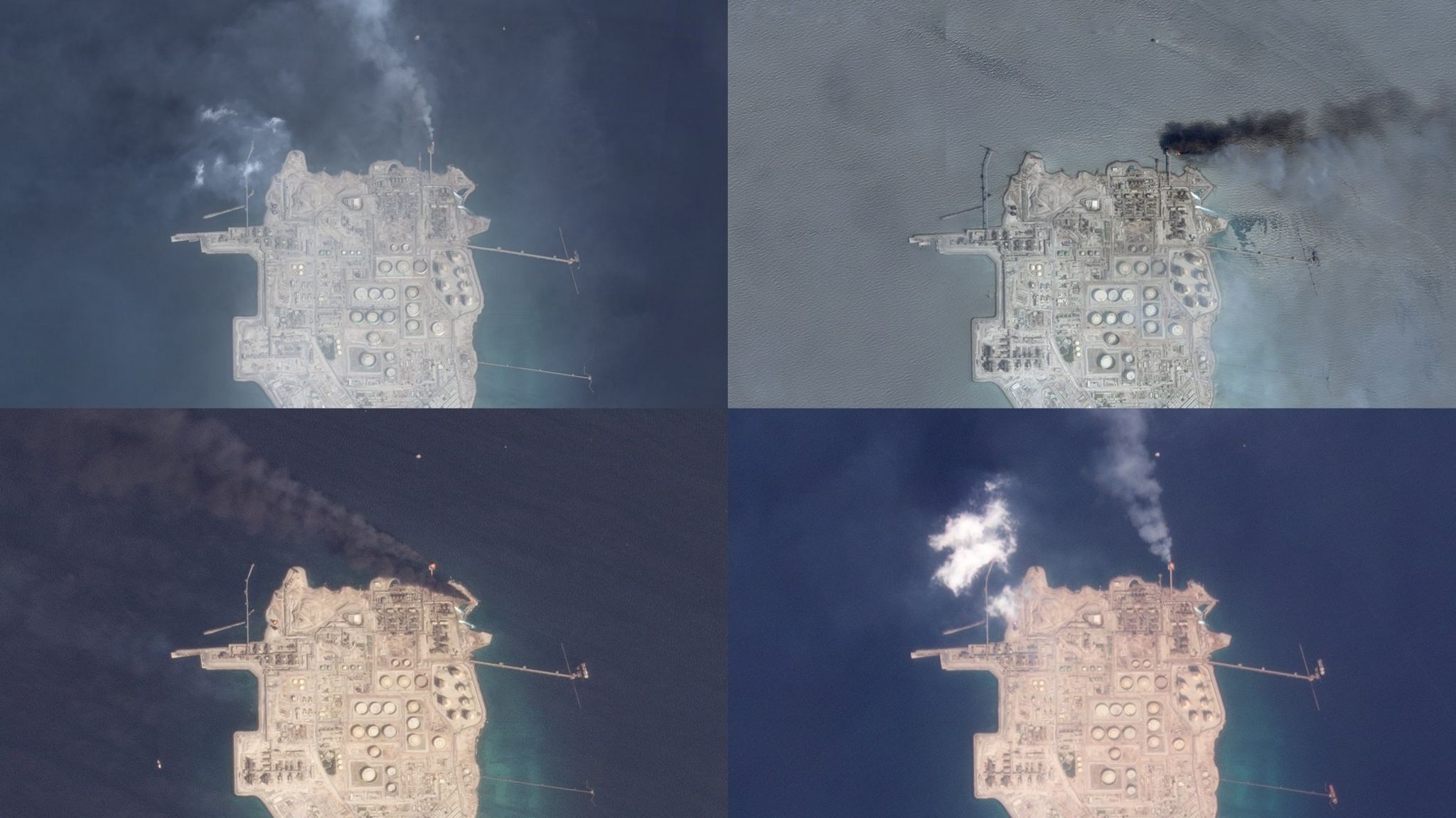
The UAE banned flaring 20 years ago, but images show it is continuing, despite the potential health consequences for its inhabitants and those in neighbouring countries.
Analysis for BBC Arabic shows gasses are now spreading hundreds of kilometres across the region.
Pollution from wells in Iraq, Iran and Kuwait were also analysed as part of the study. All of the countries involved either declined to comment or did not respond.
Oil companies managing the sites, including BP and Shell, where flaring took place said they were working to reduce the practice.
On Monday, BBC News revealed leaked documents showed how the UAE had planned to use its role as the host of UN climate talks as an opportunity to strike oil and gas deals.
David R. Boyd, the UN Special Rapporteur on human rights and the environment said the BBC’s findings were: “Very disturbing. Big oil companies and states in the Middle East are violating the human rights of millions of people by failing to tackle air pollution from fossil fuels.
“Despite the massive human suffering, Big Oil and petrostates carry on with business as usual with total impunity and zero accountability.”
Breathless
How the hidden toxic air pollution of the oil giants is spreading hundreds of kilometres, putting the health of millions of people at risk in Dubai, Abu Dhabi, Kuwait, Iran and Iraq.
The documentary is available to watch now on BBC iPlayer (UK only) and is also being broadcast on BBC World News at 09:30 GMT on Saturday 9 December.
Flaring is avoidable and the gas can be captured and used to generate electricity or heat homes – yet it continues to take place across the world.
Pollutants from this type of flaring include PM2.5, Ozone, NO2, and benzo(a)pyrene (BaP) which at high levels or continued exposure have been linked to strokes, cancer, asthma and heart disease according to international experts including the World Health Organisation (WHO).
Global flaring is also a major source of the planet-warming greenhouse gases CO2 and methane.
Two decades ago, the UAE national oil company, Adnoc – run by the president of this year’s COP28 climate summit, Sultan al-Jaber – committed to ending “routine flaring”. Yet assessment of satellite images by the BBC shows it is taking place on a daily basis at offshore sites. The UAE is one of the biggest sources of oil for the UK market.
Reliably measuring air pollution from the flares on the ground is challenging and there is little official data.
Each time gas is flared it is known to release a certain amount of pollution. Working with BBC Arabic, environmental scientists combined this information with the volumes of gas flared – which the World Bank publishes – to work out total pollution.
A simulation based on current weather conditions then estimated how gases moved across the region.
The model suggested, for example, that three offshore fields in the UAE were adding to air pollution in Dubai and Abu Dhabi, hundreds of kilometres away.
Studies have shown that children exposed to elevated levels of PM2.5 are more likely to develop asthma and persistent wheezing than those who are not exposed.
Respiratory disease is one of the leading causes of death in the region, with the rates of asthma in UAE amongst the highest in the world.
Pollution from Iraq
The BBC analysis indicates that in the case of Kuwait, some of this man-made pollution is coming from flares 140km away in Iraq.
Iraq has the second highest volume of flaring in the world, according to World Bank data, after Russia – burning nearly 18 billion cubic metres of gas a year. This could power nearly 20 million European homes annually. The biggest single source of flaring in the world is from a giant Iraqi oil field called Rumaila, managed by BP and Petrochina. It is in southern Iraq, just over 30km (20 miles) from the border with Kuwait.
The BBC research suggests one cancer-causing pollutant called benzoapyrene was ten times higher in northern Kuwait than European safety standards.
In villages close to the flares in Iraq itself, levels of PM2.5 were also extremely high, reaching hourly peaks of 100 micrograms per cubic metre.
The WHO’s recommended safe limit is 5 micrograms per cubic metre. Even 100km away in Kuwait City, levels still reached 5 to 10 micrograms per cubic metre.
Dirty air in parts of the Gulf is often blamed on the region’s regular dust storms, but Dr Barak al-Ahmad, research fellow at Harvard T.H. Chan School of Public Health, found that wasn’t necessarily the case.
He and his team spent two years analysing Kuwait’s air and dust to find out where the pollution was coming from.
“Actually, what we found out is that only 40% comes from the desert.
“Forty-two percent comes from sources that involve power plants, and involve the oil industry, and involves all the industry that is in Kuwait and outside of Kuwait.”
According to his team’s study the remaining pollution comes from high levels of traffic in the country.
“This is man-made air pollution that we can regulate, we can reduce, we can in fact eliminate,” he told the BBC.
Dr Ahmad said PM2.5 particles get into the bloodstream of those who breathe it in and can then quickly get into their organs.
“Your kidneys, your brain, your heart, everywhere. This can lead to an acute asthmatic attack. At some point, it could be very life threatening,” he said.
Abdulrahman Alameeri, a 39 year-old engineer, lives with his family in Kuwait City and his two sons struggle with asthma. Particularly his six year-old Jassem, who has been hospitalised on multiple occasions.
He told the BBC: “The first time [Jassem] had an asthma attack, he was unable to breathe. He turned blue.”

Dr Akshaya Bhagavathula, associate professor of epidemiology at North Dakota State University, who was not involved in the BBC study, reviewed the results of our research.
“This preliminary modelling study highlights potentially substantial impacts of flaring on air quality in the Gulf region, but additional measurements and analysis are needed to comprehensively quantify health burdens.”
The oil fields in Iraq and Kuwait have complex ownership structures, allowing international oil companies like Eni, Lukoil and BP who work here to not declare all emissions from their activities.
BP is a major player in the region. It is a leading contractor working at Rumaila oil field and for Kuwait Oil Company which is responsible for 82% of flaring in the country. BP reported that it made £53m in profit last year from its operations in Kuwait.
In response BP told the BBC: “As we have stated before, BP is not and has never been the operator of the Rumaila field. Nevertheless, we continue to actively support the lead contractor in its work to help the operator of the field to reduce its flaring and emissions.”
Rumaila is operated by Rumaila Operating Organisation which is a consortium of organisations including Basra Energy Company – a partnership between BP and PetroChina.
Instead of burning the gas, it could be captured and used to power people’s homes, according to the World Bank. The initial cost of installing the technology to do so is high – the World Bank estimates globally it would cost $100bn. But if captured and sold the gas could fetch $16bn annually.
In 2013, the Iraqi government and oil and gas giant Shell set up the Basrah Gas Company to capture gas at the three biggest fields, Rumaila, Qurna and Zubair.
But since then, overall levels of flaring have remained steady – and actually increased at two of the fields, according to World Bank data.
Shell told the BBC: “Basrah Gas Company’s sole purpose is to capture gas that would otherwise be flared from three giant oilfields, which are operated by other companies. It captures more than 63% of the gas from those fields, but does not have the capacity to capture all of it.”
Lukoil told the BBC it operates “in accordance with Iraqi law”. And ENI said it “collaborates to reduce and minimize gas flaring”.
PetroChina told the BBC that they are working with BP to support the rehabilitation of Rumaila. And expressed that they are extremely concerned by the issues raised by the BBC.
Although the UAE did not respond, its national oil company, Adnoc said: “Across all our operations, we are focussed on our goal of eliminating routine flaring by 2030. We flare at a lower rate than the global industry average.”
Methodology
The contribution of flaring to the regional burden of air pollution is estimated through regional chemical-transport model (CTM) simulations. The air quality over the region has been reconstructed with and without the flare’s emissions. The use of CTM simulations allows for an estimation of how the pollutants emitted from the flares are dispersed, and their interaction with background atmospheric composition, the production of secondary pollutants and their contribution to local air quality.
The pollutant emissions from the flares were estimated from the flared gas volumes reported by the World Bank Gas Flaring Tracker and emission factors available in peer-reviewed publications and reference emission inventories guidebooks.
The simulation was limited to two monthly periods. A full year would be desirable to thoroughly describe the impact of weather variability on the atmospheric composition and air quality, but we believe that the simulation of two full months is an acceptable option to obtain a first reliable estimate of the flare’s impact under different seasonal conditions.
The atmospheric composition over the area has then been reconstructed using a three-dimensional modelling system obtained by the coupling of WRF meteorological model, and FARM CTM.
Environmental modelling: AriaNet. Methodology review from Barak Al Ahmad, Dr Aidan Farrow, Dr Eric Kort, Dr Karn Vohra, Dr Akshaya Bhagavathula, Dr Ravi Ravishankara.
DISCLAIMER: The Views, Comments, Opinions, Contributions and Statements made by Readers and Contributors on this platform do not necessarily represent the views or policy of Multimedia Group Limited.
- President Commissions 36.5 Million Dollars Hospital In The Tain District
- You Will Not Go Free For Killing An Hard Working MP – Akufo-Addo To MP’s Killer
- I Will Lead You To Victory – Ato Forson Assures NDC Supporters
Visit Our Social Media for More
About Author