Confiscated letters written to Moroccan men from Spanish women decades ago reveal a history of taboo affairs during the colonial era.
“When will you come back to Spain?” The desperate-sounding plea had been carefully written out on the page, a sign of how important it was for Carmela.
“Tell me that you are not looking at any other women,” she wrote from Granada in 1944.
But the man these words were intended for never got to read them. Carmela’s international love letter did not make it to its destination in Morocco.
Instead, it ended up hidden deep in the Spanish archives, in an unexpected stash of hundreds of amorous messages between Spanish women and Moroccan men.
Seized between the 1930s and the 1950s, they chronicle forbidden intimate relationships.
For decades, colonial authorities of the Spanish protectorate in Morocco systematically seized this mail.
The boxes are full of words of passion: “I am crazy for you… I am like a goat for you,” writes one woman from Valencia.
Some contain photographs. Inserted in letter after letter, there are dozens of portraits of women with immaculate hairdos posing to remind their distant lovers what they looked like. One sent a picture of herself riding a bicycle, a carefree snapshot of everyday life.
All were neatly filed away in envelopes by conscientious bureaucrats, and then forgotten amid routine administrative documents.
They accumulated dust until they were found and published by academics Josep LluísMateo Dieste and Nieves Muriel García.
Each letter contains a tantalising glimpse into an entire relationship, but each one also tells us about the repression that these relationships faced.
Spanish officials tried everything they could to make these relationships impossible.
As one directive stated in 1937: “As a general rule, marriages between Moroccan soldiers with Spanish women must be prevented.”
Since 1912, Spain had claimed sovereignty over part of Morocco as a protectorate, dividing the country into two zones, along with France.
Fighters form the Berber community resisted this, most notoriously in the long and bloody Rif War between 1921 and 1926, which saw the Spanish army decimated by forces led by Abdelkrim al-Khattabi.
To overcome this challenge, the Spanish government increased the number of its troops in Morocco and recruited thousands of Moroccans to serve in its army.
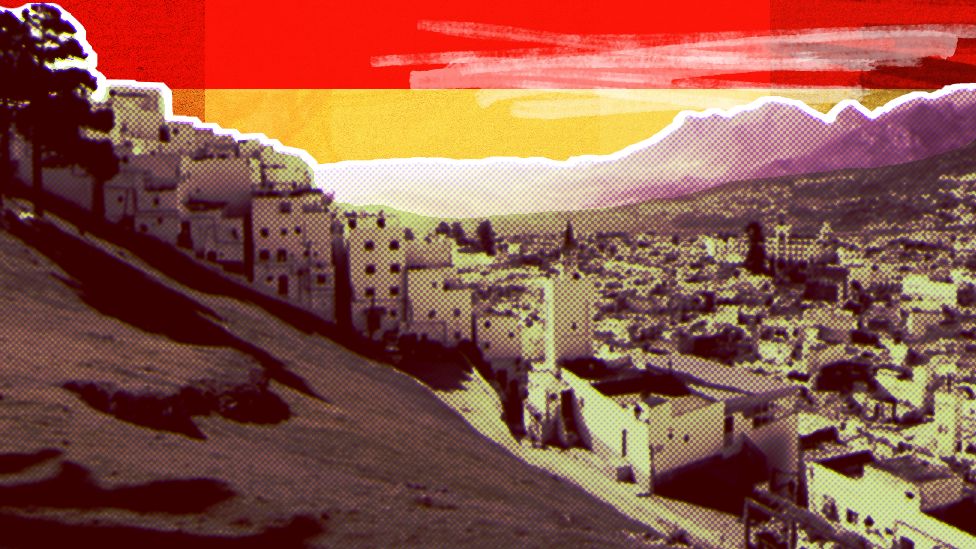
By the 1930s a long strip along the north of the country, from the Atlantic coast in Asilah almost up to the border with Algeria in the east, was effectively administered by Spain with its capital in Tetouan.
It was from the military bases in this territory that in 1936, Gen Francisco Franco launched a coup against the Republican government, starting the Spanish Civil War.
As the war raged on, suddenly thousands of Moroccan men conscripted into the Spanish military were sent across the sea to Spain to fight alongside Franco’s forces.
Beyond the military, students, traders and other workers also joined them and ended up living around the country, in cities as well as more remote rural locations.
After all, unlike many European colonial possessions, this one lay just a stone’s throw away from Spain itself – at its narrowest in the Strait of Gibraltar, the Moroccan coast is only 14km (8.5 miles) away from the southern tip of the Iberian peninsula.
Wherever they went, Moroccan men met Spanish women.
In Salamanca, a woman named Concha met Nasar, a Moroccan soldier stationed nearby.
Madly in love, she wrote to his superiors for permission to marry him in 1938. But for Spanish colonial authorities, such contact absolutely had to be banned.
They expressed disgust at Concha, who they disparaged as old, “ugly, fat like a hippo and with a slight limp”.
They suspected that Nasar had only shown interest because Concha happened to own a house, which is what awakened his “volcanic love”.
Official orders were to place “as many difficulties as possible” to prevent these relationships “without openly banning them”, as one order put it in 1937.
Indeed, as the Franco regime relied on the loyalty of Moroccan soldiers, they did not make such relationships explicitly illegal. Instead, they developed a whole series of means to make them impossible in practice.
For example, if a woman was found to be writing to a Moroccan man, they would ban her from entering Morocco.
Often, they would also ban the Moroccan man from entering Spain, rendering their relationship impossible.
In 1948, a letter was intercepted between Carmen from Zaragoza to her lover Abdeselam in Morocco. The authorities in Tetouan immediately banned both from crossing to the opposite side.
In the letter, Carmen gave news of their daughter, who would now grow up without ever seeing her father. The officials did not take the child into consideration.
Why did they regard these relationships with such contempt?
Part of the answer lies in the dictatorship’s reactionary ideology.
Franco’s government was aggressively misogynistic, rigidly controlling the mobility of women and restricting their access to employment.
It also saw itself as a defender of Catholicism, and for religious reasons, women who married Muslim men were seen as “lost to the faith”.
But the biggest single reason was what officials called “prestigio de raza”, “the prestige of the race”.
For colonial rule to continue, Spain had to be seen as superior to Morocco.
As the government understood marriage to be the subordination of a woman by a man, any marriage across the colonial divide would make a Spanish woman subservient to a Moroccan man.
If this came to be known, it would undermine the very basis of colonial domination.
By contrast, relationships between Spanish men and Moroccan women, which were plentiful in the protectorate, did not attract such extensive scrutiny and censorship as they reproduced the larger power structure of society on an intimate scale without threatening it.
This was not specific to Spain: the fear of European women entering into relationships with colonised men was common across all European colonial administrations.
In the neighbouring French zone, officials expressed similar disapproval for the political consequences of these relationships.
The Dutch in the East Indies and the British in India saw relationships between European women and colonised men as much more threatening than the reverse, and policed them accordingly.
While the range of measures to discourage these relationships went from disapproval to outright bans, the underlying rule was the same: such relationships were a threat.
These letters, however, reveal that beneath the surface of colonial society, encounters were common and led to a whole range of relationships: friendships, courtships, sexual encounters and marriages.
Opening them is thrilling – a window into lives that official documents rarely tell us about. But it is also unsettling – most letters never made it to their destination. It feels like an invasion of privacy, as these people never chose to be included in this archive.
When Morocco became independent in 1956, the protectorate government in Tetouan shut down and its archives were mostly forgotten.
They ended up mostly near Madrid, in the central archives of the administration in the university town of Alcalá de Henares where – like most of Spain’s colonial history in Africa – they were forgotten.
But despite the recent publication of some of these letters, their stories remain poorly known, and this long-forgotten archive has not yet revealed all of its secrets.
DISCLAIMER: The Views, Comments, Opinions, Contributions and Statements made by Readers and Contributors on this platform do not necessarily represent the views or policy of Multimedia Group Limited.
- President Commissions 36.5 Million Dollars Hospital In The Tain District
- You Will Not Go Free For Killing An Hard Working MP – Akufo-Addo To MP’s Killer
- I Will Lead You To Victory – Ato Forson Assures NDC Supporters
Visit Our Social Media for More
About Author