Dr. Dennis Nsafoah
Introduction
On November 12, 2026, Ghana’s Minister for Finance, Dr. Cassiel Ato Forson, is expected to present the 2027 Budget, which the government is promoting as the beginning of a New Economy. At the centre of this agenda is a proposed US$10 billion investment programme over four years, targeting infrastructure, agriculture, manufacturing and other productive sectors.
The shift from macroeconomic stabilisation toward investment-led growth is a welcome policy direction. Having made significant progress in restoring macroeconomic stability, Ghana now has an opportunity to build on these gains by addressing structural constraints to economic growth, expanding productive capacity, creating sustainable employment and improving household incomes.
However, the proposed New Economy raises three important economic policy questions: How much of the announced investment is genuinely new? How will the government finance the larger fiscal deficit? And how will the investment programme be reconciled with the government’s ambitious foreign reserve accumulation strategy?
These questions deserve careful consideration ahead of the budget presentation.
1. How Much of the New Economy Investment Is Genuinely New?
The government intends to reduce its primary surplus target from 1.5% of GDP to 0.5% in 2027, creating additional fiscal space equivalent to approximately 1% of GDP. Preliminary announcements also suggest additional revenue mobilisation of 0.5% of GDP, potentially increasing total fiscal space by 1.5 percentage points.
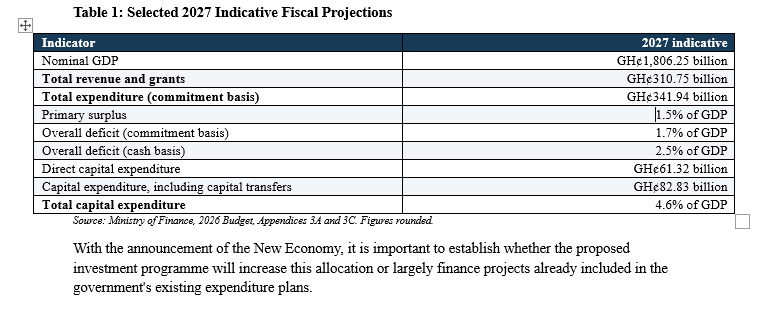
However, the 2026 Budget had already projected capital expenditure of 4.6% of GDP for 2027, a level arguably inadequate for an economy facing significant infrastructure deficits and an urgent need for productive investment. The critical question is therefore how much additional investment the New Economy will deliver beyond this already modest allocation.

With the announcement of the New Economy, it is important to establish whether the proposed investment programme will increase this allocation or largely finance projects already included in the government’s existing expenditure plans.

If the entire additional fiscal space were allocated to capital expenditure, the public investment-to-GDP ratio could theoretically increase from 4.6% to 6.1%.
The critical question is whether the forthcoming budget will deliver an increase of this magnitude or whether the New Economy will largely incorporate projects already included under the Big Push Infrastructure Programme, the 24-Hour Economy initiative and other existing commitments.
If the government is genuinely committed to investment-led growth, the minimum expectation should be that the entire additional fiscal space of 1.5% of GDP is channelled into growth-enhancing expenditure, with an increase in capital expenditure from 4.6% to approximately 6.1% of GDP providing a measurable benchmark. The ultimate test, however, is whether this additional spending expands productive capacity, stimulates private investment and creates sustainable employment.
2. How Will the Government Finance the Larger Fiscal Deficit?
A reduction in the primary surplus from 1.5% to 0.5% of GDP would, holding other fiscal aggregates constant, increase the overall cash deficit from approximately 2.5% to 3.5% of GDP.
This raises an important financing question, particularly because Ghana has substantial debt repayment obligations and the government has indicated that it does not intend to return to the international Eurobond market.

The 2026 budget already envisaged substantial reliance on domestic borrowing in 2027, partly because external debt amortisation was expected to exceed new external disbursements.
With the government ruling out Eurobond issuance, additional fiscal financing would likely have to come primarily from the domestic financial market.

Under these assumptions, net domestic financing would increase from GH¢72.5 billion to approximately GH¢90.6 billion, an increase of nearly 25%.
This does not necessarily pose an immediate threat to debt sustainability. The IMF’s July 2026 assessment upgraded Ghana’s debt-distress risk to moderate and projected public debt at approximately 54.9% of GDP in 2027, under a framework incorporating the revised primary surplus target.
The more immediate question is whether the domestic financial market can accommodate the additional borrowing without undermining the recovery in private-sector credit
The Bank of Ghana’s September 2026 Monetary Policy Report reveals encouraging developments. By August 2026, private-sector credit was growing at 35.5% in nominal terms and 29% in real terms, compared with 13.3% and 1.7%, respectively, a year earlier. Average lending rates had declined from 24.2% to 15.9%, while banking-sector liquidity remained comfortable. These developments suggest improving financing conditions for private investment.
However, the government’s increased domestic borrowing requirement could compete with this recovery, particularly as private-sector credit demand strengthens. Although domestic liquidity conditions are currently favourable, the Bank of Ghana reports limited activity in longer-term government securities, raising questions about the maturity structure and cost of additional borrowing.
The 2027 Budget must therefore provide a credible domestic financing strategy that demonstrates how the government intends to accommodate higher borrowing while preserving affordable credit for private investment. After all, an investment-led growth strategy would risk undermining its own objectives if increased public borrowing significantly crowded out the private investment it seeks to stimulate.
3. The New Economy and GANRAP: A Potential Policy Trade-Off
The third question concerns the compatibility of the New Economy with the Ghana Accelerated National Reserve Accumulation Policy (GANRAP), particularly its ambitious target of 15 months of import cover by 2028.
The magnitude and feasibility of this target deserve scrutiny. According to the Bank of Ghana, gross international reserves declined from US$13.83 billion (5.7 months of import cover) in December 2025 to US$11.07 billion (4.2 months) in August 2026. At August’s implied monthly import-cover denominator, reaching 15 months would require reserves of roughly US$39.5 billion—about US$28.5 billion above the August stock within approximately two years. Meanwhile, scheduled external debt amortisation is projected to increase from GH¢24.8 billion in 2026 to GH¢35.5 billion in 2027, representing substantial foreign-exchange obligations that must be accommodated alongside the reserve accumulation strategy.
These obligations coincide with the government’s intention to accelerate productive investment under the New Economy, which will likely increase imports of machinery, equipment and intermediate inputs before generating additional export earnings. Consequently, the government faces the challenge of simultaneously financing investment-related imports, meeting rising external debt obligations and accumulating international reserves at an unprecedented pace.
The potential fiscal trade-off is equally important. In the 2026 Mid-Year Budget Review, the government allocated GH¢5 billion to GoldBod while reducing planned capital expenditure by an equivalent amount. Although acquiring reserve assets differs from ordinary expenditure, these adjustments raise questions about the opportunity costs of prioritising reserve accumulation over growth-enhancing investment.
While stronger international reserves and productive investment can reinforce each other over time, the scale and timing of GANRAP’s targets raise legitimate questions about their compatibility with the New Economy. The 2027 Budget must therefore provide a convincing explanation of how the government intends to reconcile these competing demands without allowing the pursuit of an exceptionally ambitious reserve target to constrain productive investment and economic growth.
Conclusion
The New Economy represents an opportunity for Ghana to translate recent macroeconomic stability into sustained economic growth. However, its success will depend on whether the government channels the additional fiscal space into genuinely productive investment, finances the resulting deficit without undermining private-sector credit, and reconciles its growth ambitions with GANRAP’s aggressive reserve accumulation targets. The 2027 Budget must demonstrate that these policy objectives are mutually consistent and, ultimately, capable of delivering higher productivity, employment and household incomes.
DISCLAIMER: The Views, Comments, Opinions, Contributions and Statements made by Readers and Contributors on this platform do not necessarily represent the views or policy of Multimedia Group Limited.
DISCLAIMER: The Views, Comments, Opinions, Contributions and Statements made by Readers and Contributors on this platform do not necessarily represent the views or policy of Multimedia Group Limited.
- President Commissions 36.5 Million Dollars Hospital In The Tain District
- You Will Not Go Free For Killing An Hard Working MP – Akufo-Addo To MP’s Killer
- I Will Lead You To Victory – Ato Forson Assures NDC Supporters
Visit Our Social Media for More
About Author