In Ghana these days, journalism is no longer only threatened in courtrooms or conflict zones. Increasingly, the most dangerous frontline in the battle against press freedom in Ghana is digital.
Reporters who investigate politics, corruption, conflict and human rights are facing a growing wave of cyber-enabled attacks, ranging from coordinated online harassment and disinformation campaigns to hacked messaging accounts, compromised news websites and threats that spill into real-world danger.
What makes this new threat especially insidious is its reach. A single post can trigger thousands of hostile messages, a hacked WhatsApp account can collapse months of investigative work, an online smear can isolate a journalist socially, professionally and psychologically – all without a single physical confrontation.
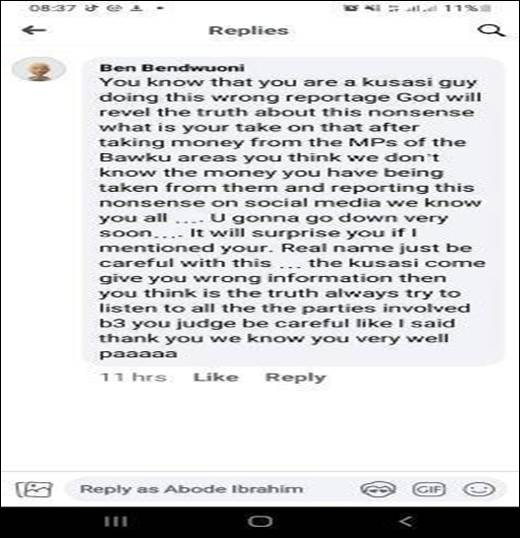
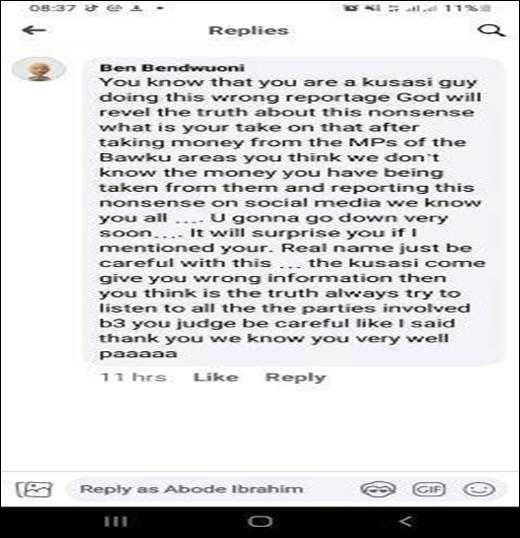
For many journalists, the consequence is not just fear, but disrupted reporting, disrupted livelihoods and disrupted lives.“During this period, I lived like a fugitive,” says Ghanaian journalist, Ibrahim Abode, formerly with Channel One TV, as he describes the harrowing weeks between February and April 2025 when online threats forced him into hiding.
The messages were sent by individuals linked to factions involved in the decades-long Bawku chieftaincy conflict.
“After I reported on killings in both Bawku and Walewale, I was constantly in hiding,” he recalled in a chat with The Fourth Estate. “Whenever I went out, I wore a nose mask to conceal my identity.”
The violence he reported was brutal and unrelenting. In one incident, a bus traveling from Kumasi to Garu was ambushed by gunmen moments after stopping in front of the ADB Bank in Walewale. The attack, allegedly linked to the Bawku chieftaincy conflict, came just days after a similar assault when three passengers were killed and their bus set ablaze near Wulugu on the Bolgatanga-Tamale highway.
“Their concerns were that I had reported on some of the killings of people, including women and children,” he recalls.
“The online threats and trolling flooded my phone, turning a digital intimidation into a fear that reshaped my daily life.”

Despite the threats, he believes his reports helped police to bring the culprits to book.
“When I reported, the security [officials] went there, arrested some people and then imposed curfew on the area,” Abode says.
But the threats did not stop with him. Some targeted his immediate family, pushing his mother into a state of fear that saw her begging him to abandon journalism altogether.
As pressure mounted, Abode lost his job at Channel 1 TV. He believes his dismissal was prompted by one of his responses to some of the people who were threatening him. His former employers reportedly insisted that his response was “rude”.
“I am completely traumatised psychologically and still struggling to find my feet,” Abode says with a hint of regret.
A silent takeover
While Abode faced threats linked to violent conflict, Thelma Dede-Amedeku, an investigative journalist and fact-checker with The Fourth Estate, encountered a different form of digital attack: the takeover of her WhatsApp account.
The first sign came in the form of strange messages. These were repeated prompts requesting verification codes she had never asked for. Because she had activated two-factor authentication, she ignored them. But on November 7, 2025, everything changed.
“I got a notification that I had been logged out. I couldn’t log back in,” she says.
Suddenly, she lost access to the platform that held conversations with sources.
“I almost cried. I had sensitive information there. And the person who took over could have accessed all of it. That was terrifying,” Dede-Amedeku stated.
Her organisation had already faced a separate incident where their website was compromised, and stories were wiped from the server. But this personal attack struck harder. The takeover happened at a time when her editor was also experiencing a similar block on WhatsApp, prompting suggestions that both incidents were connected to their work — particularly given their roles in fact-checking and accountability journalism.
She reported the issue, eventually receiving support from the Cybersecurity Authority and Meta to retrieve her account after several days of uncertainty.
Digital attacks increasing in frequency and severity
Philip Kwasi Banini, Team Lead at iWatch Africa, explains that attacks on digital platforms as experienced by Miss Dede-Amedeku and Mr. Adobe are increasing in both frequency and severity across Ghana.
“Reports from the DisinfoEye initiative shows that insults dominate at 70%, followed by sexual harassment at 20%, and defamation/smear campaigns at 10%,” Mr. Banini told the Fourth Estate. “Approximately 60% of abuse targets female journalists, who face additional gendered attacks such as body-shaming and sexualised threats. 80% of cases occur on X (formerly Twitter), 20% on Facebook. Political commentary drives 50% of abuses, followed by cultural issues (30%) and corruption (20%).”
According to Mr. Banini social media platforms have become the primary battleground for these attacks, making them more public, rapid and harder to trace.
Data by iWatch Africa shows that 502 instances of online abuse were documented in just three months of 2025. In 2020, it recorded over 5,000 cases targeting journalists and rights activists.
The data gathered between July and September 2025 revealed that journalists Richard Dela Sky, Berla Mundi, Serwaa Amihere, and Manasseh Azure Awuni were among the most abused, highlighting a significant threat to press freedom and democratic dialogue.
“Women journalists are disproportionately targeted, attacks often follow stories on corruption, politics, or other contentious issues and coordinated online abuse – rather than random trolling – is increasingly common,” the report noted.
In Ghana, gaps within the legal and institutional frameworks further expose journalists, leaving many without meaningful avenues for redress, according to Mr. Banini.
Cybersecurity and legal experts say that the solution is not merely to pass new laws, but to properly test and enforce existing ones.
Desmond Israel, a lawyer and technology governance expert, told The Fourth Estate that Ghana already has several statutes capable of addressing many of these digital abuses, but they remain largely underutilised.
For example, Mr. Israel argued that Ghana must first examine whether current laws, such as the Criminal Offences Act, the Electronic Transactions Act, the Data Protection Act, and the Cybersecurity Act, already contain provisions that can be leveraged to protect journalists before rushing to pass new legislation.
“You can make laws, but if people are not putting those laws to the test, you’ll never feel their impact. The laws we have are broad. They were not written with today’s platform-driven abuse in mind. When journalists report digital threats, the question becomes: does this fit into an existing offence? That ambiguity leaves many unprotected,” he says.
“Our mechanisms for reporting are fragmented. A journalist may report to the police, but the police may not have the training for digital forensics. Cybersecurity bodies may have capacity, but not the mandate to prosecute. That disconnect leaves attackers emboldened.”
The authors, Juliet Etefe and Winifred Lartey, are 2025 Fellows of the Next Generation Investigative Journalism Fellowship – Cohort 7 at the Media Foundation for West Africa.
- President Commissions 36.5 Million Dollars Hospital In The Tain District
- You Will Not Go Free For Killing An Hard Working MP – Akufo-Addo To MP’s Killer
- I Will Lead You To Victory – Ato Forson Assures NDC Supporters
Visit Our Social Media for More
About Author