

The Western Regional House of Chiefs has issued a strong warning to government to ban raw rubber exports or risk deepening factory shutdowns, mass job losses and wasted industrial potential in Ghana’s leading rubber-producing region.
The House is calling for a total ban on the export of raw natural rubber, insisting that proposed restrictions announced in the 2026 Budget will not be enough to protect domestic processors or advance Ghana’s industrialisation drive.
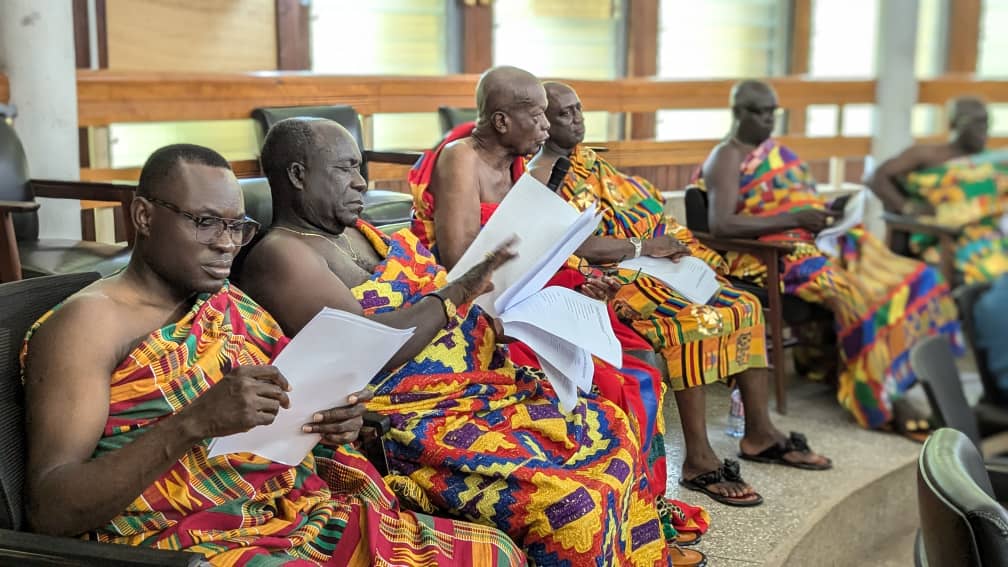
At a general meeting in Sekondi, President of the House, Nana Kobina Nketsia V, said chiefs across the region are unanimous in backing a complete policy overhaul that stops the export of natural rubber in its raw form.
“It was clearly stated in the 2026 Budget that the discussion was about natural rubber. However, the way the minister framed it suggested a restriction on the export of raw rubber,” Nana Nketsia said. “We are not asking for a restriction; we are asking for a total ban.”
He argued that the continued shipment of raw rubber abroad particularly from the Western Region, Ghana’s biggest rubber-producing enclave undermines the government’s own agenda on value addition, job creation, and local content development.
According to him, a full ban would guarantee reliable access to raw materials for local processors, revive distressed rubber-based industries, and align fully with initiatives such as the proposed 24-hour economy.
The Paramount Chief of Essikado warned that uncontrolled exportation has already weakened major processing firms. He cited the case of Ghana Rubber Estates Limited (GREL), which he said has been forced to slash its labour force by half and reduce operations from three shifts to one due to inadequate raw material supply.
Industry actors have raised similar concerns. The Association of Natural Rubber Actors of Ghana (ANRAG) recently confirmed that a processing company in the Central Region has shut down entirely because it could no longer secure raw materials and GREL is also on the verge of closing one of its two factories by 2026.
Although the Parliamentary Select Committee on Trade and Industry has thrown its support behind government’s plan to restrict raw rubber exports beginning in 2026 and is expected to help draft a Legislative Instrument Nana Nketsia insists that restriction alone will not fix the problem.
“Exporting raw rubber directly contradicts the government’s stated policy direction and undermines the domestic industry,” he said. “If we are serious about industrialisation, then we must process our rubber here instead of exporting it in its raw state.”
He further called for stronger enforcement of export regulations, saying Ghana’s challenge lies more in weak implementation than lack of policy.
“There are laws against exporting materials in their raw form. We must ensure the regulatory framework functions effectively. This is not just for producing areas, but for the benefit of the entire country,” he added.
Touching on wider natural resource management, Nana Kobina Nketsia drew parallels with Ghana’s mining sector. He questioned why the proposed national gold refinery would be sited in Accra instead of the Western Region, where much of the gold is mined.
“If the gold is mined here, why should the refinery be in Accra?” he asked. “If the aim is to create jobs and curb illegal mining, then these facilities must be located in the producing regions.”
The Paramount Chief of the Gwira Traditional Area, Awulae Angamatuo Gyan, backed the call, revealing that traditional authorities in the region have engaged the Ministry of Trade and Industry and the 24-Hour Economy Secretariat on the matter.
“We have raised concerns about raw rubber exports for many years through engagements with relevant institutions. Although the results have been slow, we are hopeful that government’s current position on restriction will be a stepping stone toward a full ban,” he said.
Also speaking, Awulae Attibrukusu, Paramount Chief of the Axim Traditional Area, said while he welcomes government’s plan to restrict exports, chiefs in the Western Region must mount a united front to secure a complete ban.
“As a region, we must come together and meet the relevant authorities to clearly state our resolve to have a total ban on raw rubber exports,” he said.
He proposed a joint petition by chiefs, opinion leaders and other stakeholders in the region to formally communicate their position to government and Parliament.
The Western Region remains Ghana’s largest producer of natural rubber, supporting thousands of smallholder farmers and several large plantations. Chiefs argue that banning raw exports will stimulate local processing, create thousands of direct and indirect jobs, boost government revenue and unlock long-term industrial growth
- President Commissions 36.5 Million Dollars Hospital In The Tain District
- You Will Not Go Free For Killing An Hard Working MP – Akufo-Addo To MP’s Killer
- I Will Lead You To Victory – Ato Forson Assures NDC Supporters
Visit Our Social Media for More
About Author