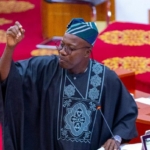
Majority Leader, Mahama Ayariga, has said the Office of the Special Prosecutor must be scrapped. He cites various reasons including the duplication of the function of the Attorney General’s Department.
He believes that resources allocated to the OSP must be used to strengthen the AG’s Department.
Here is the full video of his submission in Parliament.
Here is the full transcript of his submission:
Transcript of Mahama Ayariga’s submission on floor of Parliament proposing the scrapping of the OSP.
In your remarks, you raised the issue of the Office of Special Prosecutor and some discussions that took place earlier in this house. Mr. Speaker, I think that this house, as a body, needs to take some firm decision on the issue of the institution of the Office of Special Prosecutor and make sure that we take advantage and realign our constitution properly. Mr. Speaker, yesterday the office arrested and detained a legal practitioner by the name Mr. Martin Kwebu.
Mr. Speaker, it is obvious that that practitioner had publicly criticized the manner in which the Special Prosecutor was going about performing his functions. He was invited and I am told that at the entrance to the Office of Special Prosecutor, he sought to address the media, which was objected to by the security detail at the office. And I think there was some altercation between him and the security responsible for the building that houses the Special Prosecutor.
Subsequently, it was ordered that he should be detained. It took the intervention of most Ghanaians on social media and people calling the Special Prosecutor and demanding that he should release the legal practitioner. Majority Leader, the difficulty the House has is that this was extensively deliberated upon, led by your Majority Chief Whip.
And so it will be like we are repeating what was said. For emphasis, you want it for emphasis? Well, if that is the sense of the House, I will grant him the opportunity. Because I have a few things to say about this matter.
But Majority Leader, they say for emphasis, you could go on. Yes. Speaker, I support the Majority Leader fully in re-conversing the issues.
And, Speaker, he should do that with all the diligence. And we support him. Please proceed.
Honourable Members, this matter is so endemic that it doesn’t deal with any regime. Let’s all be honest. It cuts across all the regimes and even goes beyond the constitutional bodies or even the OSP.
To a culture even in the Ghana Police Service, the military, in fact the security agencies. They think that when somebody is invited, the person is arrested. And the law is very clear on this matter.
So please, don’t let’s bring partisanship into it. Let’s look at it as we have all experienced it over the years and try to prescribe the way forward. So, Majority Leader, you may go on.
Thank you very much, Mr. Speaker. Mr. Speaker, so the lawyer Martin Kwebu was subsequently released last night. But it raises fundamental issues about the very existence of that office.
Mr. Speaker, I recall vividly in this chamber when the proposal to establish the Office of Special Prosecutor was presented. I opposed it. I opposed it.
The Hansard will bear me out. Because I took a position that it is unconstitutional to strip the Attorney General of the power to be responsible for the prosecution of criminal cases. Even though there was a contrivance to struggle to appear to be aligning with the language of the Constitution.
By nuancing the processes for the appointment of the Special Prosecutor. And to say that the actual Special Prosecutor is being nominated by the Attorney General for approval by the Parliament. So in that sense, the exercise of the prosecutorial powers is being done by the OSB with the authorization of the Attorney General.
It still doesn’t make sense. The fact that we had to struggle and nuance the whole process clearly betrays the fact that we knew we were doing something that didn’t sit well with our constitutional architecture. Mr. Speaker, the office has been in existence for how many years now? Close to eight years.
Tell me what is really the achievement of that office? What has been the achievement of that office? I cannot see my way clear in terms of the achievement of that office. I have consistently held the position that fighting corruption is not about littering the place with institutions. It is the political commitment of those who lead that fight corruption.
Not the designations of institutions that have been established. I believe that it is high time that this Parliament reconsider its decision to approve the establishment of the Office of Special Prosecutor. I think that we should abolish it.
I honestly think we should abolish it. Because we’ve experimented it and we cannot see any achievement. Major cases of clear corruption.
Up to date, the office has not been able to do anything. So it cannot do anything. If the institution of Attorney General that we establish in our constitution is adequately resourced and protected by Parliament and held accountable by Parliament, I believe that that office will equally deliver.
No ministry, no office is established. If you look at the cabinet, no office is expressly established by this constitution apart from the Attorney General and Minister for Justice. It is the only one that is actually a constitutional entity.
And so it is an entity that this Parliament should ensure that it is resourced and protected so that it stands above ordinary ministries. And can ensure that criminality is dealt with in this country. Look at the budgeting.
If we agree that a prosecutor fighting corruption needs to be resourced, why have we not been resourcing the Attorney General? Why do we establish an entity out of the functions of the Attorney General and resource them more than the Attorney General? And even after doing that, it is still not delivering. So Mr. Speaker, yesterday I am told, I didn’t see it but I am told, that your predecessor, the Right Honorable Michael Quay, who spoke here on TV3, indeed recommended that this House should abolish it. That we should use a private member’s bill to abolish it.
Mr. Speaker, let me sound a warning. That abolishing it will not let off the hook. Not let off the hook those who we are considering prosecuting for violations of the law when it comes to corruption.
I can assure you that abolishing the Office of Special Prosecutor will not let off anybody that is found culpable or who has violated any of the laws of this Ghana when it comes to financial accountability. Zakios will not be let off the hook. I can assure you.
So people should not see the call for the abolition of the Office of Special Prosecutor as an indication that those who are going to be held accountable will be let off the hook. Indeed, I will ensure that the process is even expedited. But I am strongly of the conviction that the Office of Special Prosecutor should be abolished.
Whether we are going to do it through a private member’s bill, as advised by Michael Quay, or that we will call on the Executive to expedite a bill that we will consider and approve to abolish it, that is for us as a House to decide. But I think that it is high time we realize that that constitutional experiment is futile. To say that because the Attorney General is appointed by the President and is a member of a political party that he will not be functional or effective in fighting corruption.
The OSP, is he coming from space? Who is nominating him? The same political process is going to generate the occupant of the Office of Special Prosecutor. So he will not be freed of that political pressure. If we want to be serious about fighting corruption, let’s do it.
Political leadership at the highest level must lead. This government has been in office for about 11 months now. Mr. Speaker, we haven’t reported a single scandal.
And we haven’t reported a single scandal because of the political commitment to ensure accountability. And we are available. Show me any scandal and we will take the person on.
Mr. Speaker, political corruption is a function of political leadership. If political leadership is determined not to be corrupt, they will not be corrupt. And when they are corrupt, they will hold each other accountable.
It’s not about creating fanciful institutions and giving them fanciful names. We have seen it. In big budgets.
With all sorts of perks. We’ve seen it. It’s lived out.
And it’s not working. Let’s go back to what the Constitution has ordained. The money that we are giving to the Office of Special Prosecutor.
Let’s resource the Attorney General’s office. And I’m sure that this particular Attorney General will produce the kind of results that we expect of him. As it is now, there is some confusion in the system.
Which corruption cases should the OSB handle? Which ones should the Attorney General handle? Which corruption cases should the Yoko investigate? And which ones should the OSB investigate? When there is a corruption case and one runs and then places its hands on it, then the other is clearly disabled from dealing with it. Even if the one that has rights first to take it is obviously not politically committed to fighting it. So there is clear confusion.
Institutions obstructing each other. Powers blocking each other. So I think that we should use this opportunity to streamline it.
Let one person lead the fight against corruption as stipulated by this Constitution. And that is the Attorney General. And that is the Minister for Justice.
And that is what is provided for in our Constitution. Thank you very much, Mr. Speaker.
- President Commissions 36.5 Million Dollars Hospital In The Tain District
- You Will Not Go Free For Killing An Hard Working MP – Akufo-Addo To MP’s Killer
- I Will Lead You To Victory – Ato Forson Assures NDC Supporters
Visit Our Social Media for More
About Author