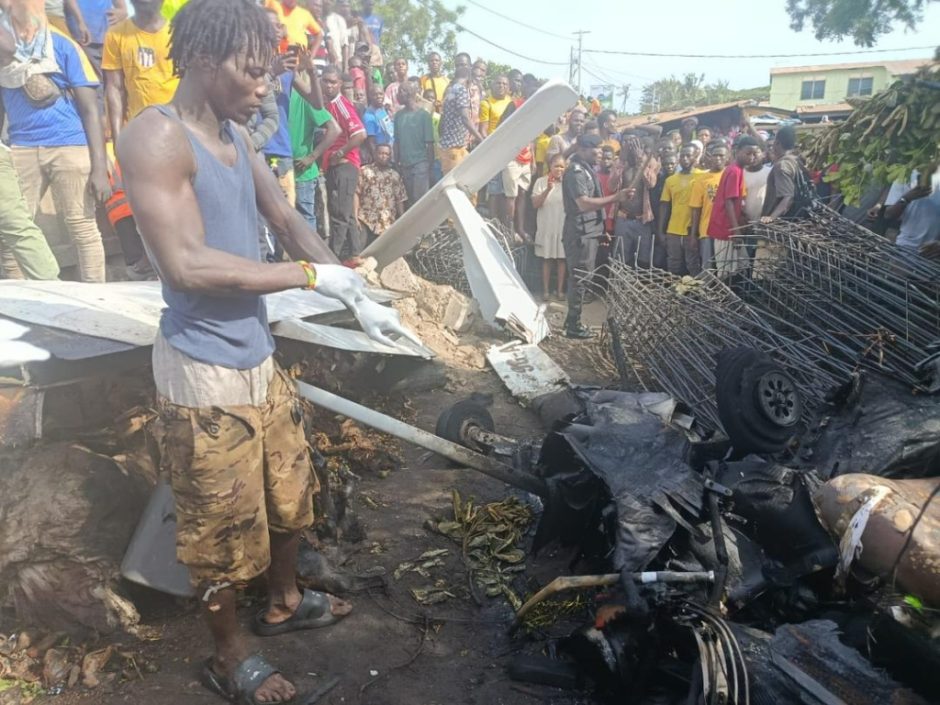
An expert in Aerospace and Aviation Medicine, Yakubu Akparibio, says it is too early to determine the exact cause of the recent aircraft crash in Tema, stressing that investigators must complete their work before any firm conclusions are drawn.
Speaking on Top Story on Joy FM, Dr Akparibio explained that preliminary information from the Ghana Civil Aviation Authority indicates that the aircraft involved was a microlight, a small and lightweight aircraft type.
His comments follow a tragic incident on Monday, March 16, when a helicopter reportedly crashed at Tema Community One, plunging into the Oninku Drive School Park and killing two people on board.
According to Dr Akparibio, it is still too early to determine what caused the accident.
“It is very early for us to know what happened, but when I look at the statements from the Ghana Civil Aviation Authority, this particular aircraft is a microlight,” he said.
He explained that microlights are typically operated in less congested airspace and are generally not flown over populated areas.
“Microlights are small aircraft and they normally don’t operate in airspace where there are people or crowded areas. Until the investigator’s report comes out, we wouldn’t know what exactly caused the accident,” he noted.
Dr Akparibio added that while microlights are not common in Ghana, they are widely used in countries such as the United States and across Europe, where their safety record has often raised concerns.
“Accidents involving microlights are quite common. They are not common in Ghana, but when you go to the U.S. or Europe, they are widely used and their safety record is very poor, so they are prone to accidents,” he said.
He further explained that regulations governing microlight operations vary significantly across jurisdictions.
In some countries, he noted, microlight pilots are not required to obtain medical certification or operate aircraft with full airworthiness certification.
“The pilot is not expected to carry a medical licence, and they are not expected to have an airworthiness certificate,” he said.
Dr Akparibio added that the operations of such aircraft are usually restricted to areas with minimal air traffic and low population density.
“Mostly, their operations are limited to where the airspace is less busy, and on the ground it will not be in areas where there are communities or many people,” he explained.
He therefore expressed surprise that the aircraft reportedly flew within the Tema airspace, which has a significant population.
Dr Akparibio reiterated that investigators must complete their work before the public can understand the real cause of the crash.
“Like I said, it is very early to know what really caused it, but they are normally not allowed to fly in areas where there is a population,” he concluded.
This website uses cookies to improve your experience. We'll assume you're ok with this, but you can opt-out if you wish. Cookie settingsACCEPT
Privacy & Cookies Policy
Privacy Overview
This website uses cookies to improve your experience while you navigate through the website. Out of these cookies, the cookies that are categorized as necessary are stored on your browser as they are essential for the working of basic functionalities of the website. We also use third-party cookies that help us analyze and understand how you use this website. These cookies will be stored in your browser only with your consent. You also have the option to opt-out of these cookies. But opting out of some of these cookies may have an effect on your browsing experience.
Necessary cookies are absolutely essential for the website to function properly. This category only includes cookies that ensures basic functionalities and security features of the website. These cookies do not store any personal information.
Any cookies that may not be particularly necessary for the website to function and is used specifically to collect user personal data via analytics, ads, other embedded contents are termed as non-necessary cookies. It is mandatory to procure user consent prior to running these cookies on your website.
This website uses cookies. By continuing to use this website you are giving consent to cookies being used. Visit our Privacy and Cookie Policy.