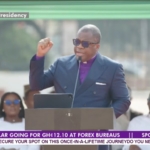
The General Superintendent of the Assemblies of God, Ghana, Rev. Stephen Wengam, has praised the country’s achievements over the past year under President John Mahama, noting that friends abroad have commended Ghana’s progress.
Rev. Wengam made the remarks while delivering a sermon during the National Thanksgiving Day at the forecourt of the presidency on Wednesday, an event held to mark President Mahama’s first anniversary in office.
“We will all agree that this past one year, we have seen the economy stabilise, and we have seen the currency doing well. I have friends from outside Ghana who have called us and are full of praise for our leader for what God has done in the past one year,” Rev. Wengam said.
“Transformation calls for thanksgiving,” he added.
Preaching from the book of 1 Samuel 7:12, he said Ghana is following a path similar to that of Israel in the scripture, highlighting the nation’s growth and resilience over the past year.
He added that the future of the country is bright.
“I came to announce that the future is very bright, the future of this country is very bright, and that is why we are gathered here today to give God praise and to celebrate God for what he is about to do.”
On January 7, 2025, President John Mahama was sworn into office as the sixth President of the Fourth Republic. He was sworn in by the Chief Justice of Ghana, Gertrude Torkornoo.
The trajectory of Ghana’s economy in 2025 was defined by a strategic pivot toward stability, underpinned by aggressive gold-backed interventions and a deliberate effort to rebuild national confidence. Following a volatile period in early 2024, the government and the Bank of Ghana implemented a series of macroeconomic refinements that yielded tangible improvements in currency performance and reserve management.
A cornerstone of this recovery was the stabilisation of the Ghana Cedi. Although the currency faced severe pressure during the first three quarters of 2024 due to energy-related payments and debt restructuring uncertainties, it began a sustained recovery in the final quarter of that year.
This momentum carried into 2025, supported by the increased participation of commercial banks in the gold purchase program and the introduction of a Gold FX Auction mechanism. This mechanism enabled a more structured and transparent intermediation of gold-related foreign exchange flows, helping to manage liquidity more effectively than in previous years.
Furthermore, 2025 saw the operational maturation of GoldBod (the Ghana Gold Board). By embedding GoldBod within the macroeconomic framework, the state was able to capture higher value from its natural resources while strengthening external buffers.
The Domestic Gold Purchase Programme (DGPP) served as a vital tool during moments of thin foreign exchange reserves, leveraging gold to stabilise the currency and create space for broader recovery.
To enhance the sustainability of these programmes, the government took the decisive step of cancelling the Gold-for-Oil (G4O) initiative in 2025, opting instead to refine the Gold-for-Reserves (G4R) framework.
Despite these successes, the Bank of Ghana candidly acknowledged that this stability came at a significant financial cost, which the central bank deliberately absorbed in the national interest to protect the wider economy.
Throughout 2025, governance was tightened, particularly within the artisanal and small-scale gold sectors, and pricing structures were improved by reducing agent fees and assay charges.
By the end of 2025, the economy moved toward a model of shared responsibility, anchoring these strategic priorities within a broader government framework to ensure that the burden of maintaining stability no longer rested on a single institution.
- President Commissions 36.5 Million Dollars Hospital In The Tain District
- You Will Not Go Free For Killing An Hard Working MP – Akufo-Addo To MP’s Killer
- I Will Lead You To Victory – Ato Forson Assures NDC Supporters
Visit Our Social Media for More
About Author