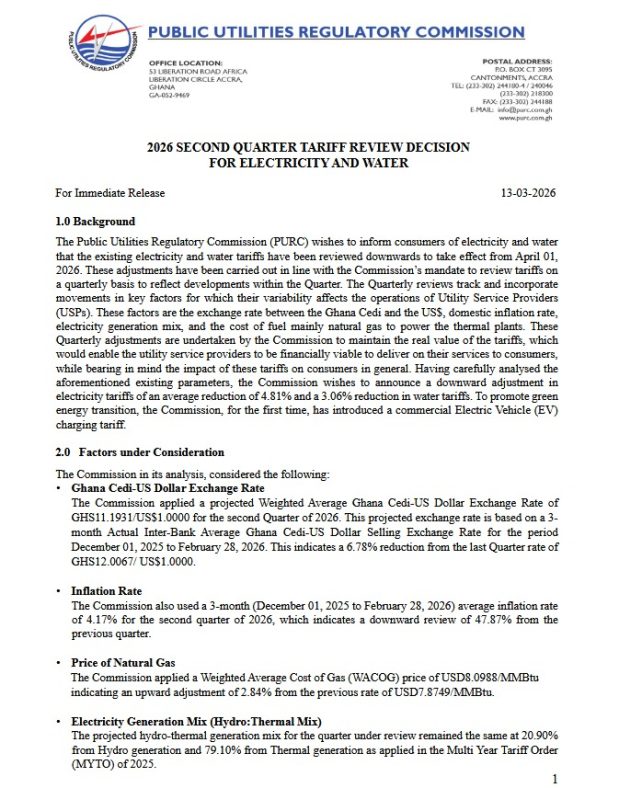
Ghanaians will pay less for electricity and water from April 1, 2026, after the Public Utilities Regulatory Commission (PURC) announced a downward review of utility tariffs, citing a stronger cedi, falling inflation, and improved macroeconomic conditions.
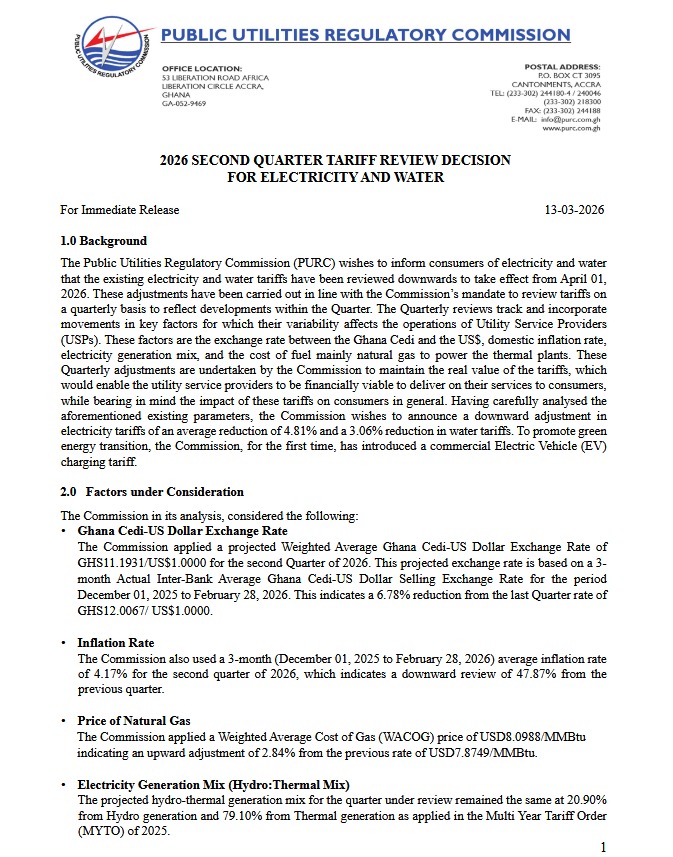
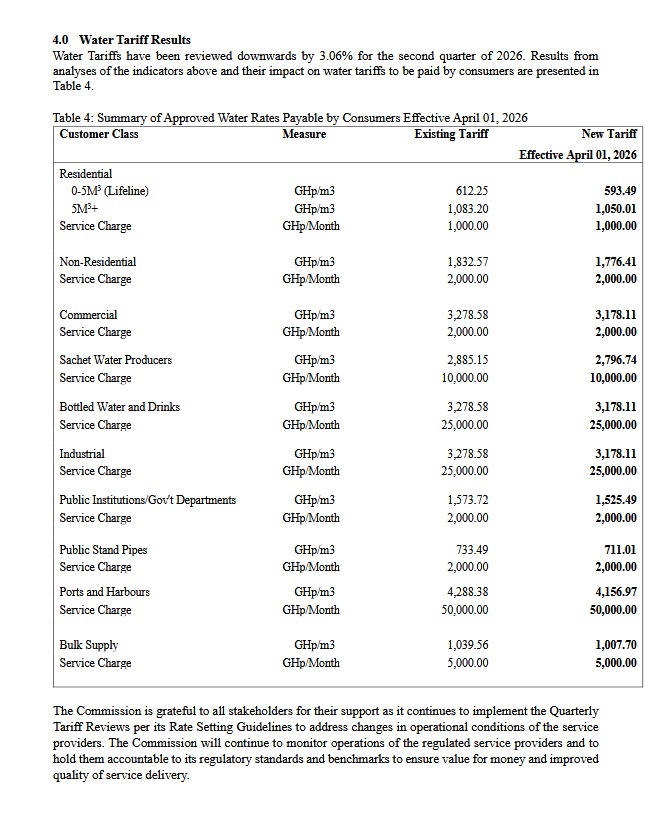
The Commission announced an average reduction of 4.81% in electricity tariffs and 3.06% in water tariffs, effective the first day of the second quarter of 2026.
“Having carefully analysed the aforementioned existing parameters, the Commission wishes to announce a downward adjustment in electricity tariffs of an average reduction of 4.81% and a 3.06% reduction in water tariffs,” PURC said in its Second Quarter Tariff Review Decision released on March 13, 2026.
The announcement is welcome relief for households and businesses that have faced persistent cost-of-living pressures over the past two years, during which utility tariffs rose sharply in tandem with cedi depreciation and high inflation.
What the new rates mean for you
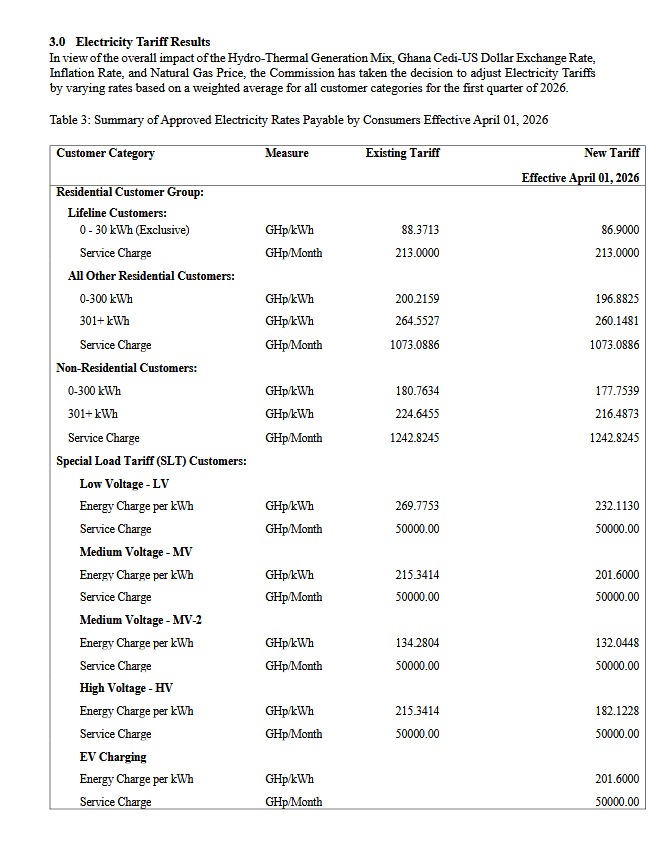
For residential lifeline customers those consuming between 0 and 30 kilowatt-hours, the electricity rate drops slightly from 88.37 GHp/kWh to 86.90 GHp/kWh.
General residential consumers using up to 300 kWh will see their rate ease from 200.22 GHp/kWh to 196.88 GHp/kWh.
Non-residential customers also benefit, with rates for 0–300 kWh usage falling from 180.76 GHp/kWh to 177.75 GHp/kWh.
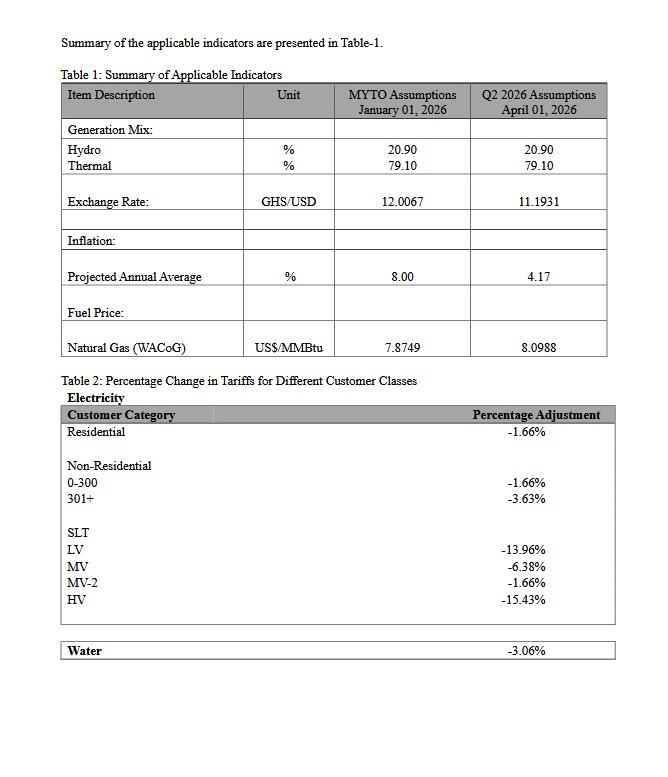
The steepest reductions are for industrial and Special Load Tariff customers, with High Voltage users seeing a 15.43% cut and Low Voltage customers benefiting from a 13.96% reduction.
On water, residential lifeline consumers those using between 0 and 5 cubic metres will pay 593.49 GHp/m³ instead of the current 612.25 GHp/m³. Commercial, industrial, and bottled water producers will also see modest reductions across the board.
Why tariffs are going down
PURC attributed the reductions primarily to the cedi’s improved performance.
The Commission applied a projected weighted average exchange rate of GHS11.1931 to the dollar for the second quarter, a 6.78% improvement from the GHS12.0067 rate used in the first quarter.
Inflation also played a significant role.
The Commission used a three-month average inflation rate of 4.17% for the period December 2025 to February 2026, nearly half the 8% assumption used in the previous quarter under the Multi-Year Tariff Order (MYTO) of 2025.
The cost of natural gas, however, moved in the opposite direction. PURC applied a Weighted Average Cost of Gas of USD8.0988 per MMBtu, up 2.84% from the previous quarter’s rate — a factor that partly moderated what could have been a deeper tariff cut.
The hydro-to-thermal generation mix remained unchanged at 20.90% hydro and 79.10% thermal.
Ghana’s first EV charging tariff
In a notable first, PURC has introduced a commercial Electric Vehicle charging tariff, set at 201.60 GHp/kWh with a monthly service charge of GHS500. The Commission described this as part of efforts to promote Ghana’s green energy transition.
The Commission said it will continue monitoring utility service providers and hold them accountable to regulatory standards to ensure value for money and improved service delivery.
The quarterly tariff review mechanism, which adjusts rates based on exchange rate movements, inflation, fuel costs, and generation mix, was designed to prevent the kind of large, infrequent tariff shocks that historically caught consumers and businesses off guard.
- President Commissions 36.5 Million Dollars Hospital In The Tain District
- You Will Not Go Free For Killing An Hard Working MP – Akufo-Addo To MP’s Killer
- I Will Lead You To Victory – Ato Forson Assures NDC Supporters
Visit Our Social Media for More
About Author