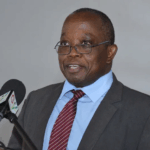
Former Auditor-General Daniel Domelevo says Ghana’s anti-corruption fight will remain weak if cases continue to drag through the courts.
He warned that prolonged trials drain public confidence and undermine accountability.
Speaking on Joy News’ PM Express on Monday, he described the judiciary as the slowest and weakest link in the country’s anti-corruption chain, as Ghana awaits the next Corruption Perception Index after years of declining scores and public frustration over stalled prosecutions.
“I don’t know what results we are going to get,” Domelevo said, adding that he expects some improvement largely because fewer corruption scandals have dominated public discourse under the current administration.
“My hope and expectation is that it should improve, in the sense that at least we have gone almost a year or a year into this new administration, and not heard of scandals as they were in the past.
“So I’m not saying they are not happening, but I’m saying we have not heard of them, so that may drive people’s perception.”
He said stronger political signals could have delivered deeper gains in public trust if key reforms had been passed.
“I will have wished that the low-hanging fruit that I talked about,” he said, arguing that a clear law on unexplained wealth would show seriousness.
“That is, if we had passed a law by now to say that once we can establish beyond a reasonable doubt that a public servant is owing or in possession of an asset which does not correspond with his or her earnings from the public service, until you can prove to us that there are other means of getting those assets you are guilty of it. Then I think people now know that, yes, there is seriousness in those things.”
Daniel Domelevo said critical legislation remains stalled. “Asset declaration law has been on the table before I became Auditor General, and it is still there,” he said, adding that the Conduct of Public Officers Bill also addresses many corruption-related issues.
He stressed that passing laws alone is not enough if trials drag on. “If we pass those laws and bring finality to the trial of cases, we don’t allow it to stand for too long,” he said.
He agreed with anti-galamsey convener Dr Ken Ashigbey on the need to reform court operations, arguing that limited sitting hours worsen delays.
“The courtroom should not be used for three or four hours a day, and it is closed, and we go home and come back the next day,” he said, adding that judges could rotate to keep courts running.
“The 24-Hour economy can go to the courtrooms so that we can get cases tried on time.”
Drawing on personal experience, Domelevo described repeated adjournments as demoralising. “It’s disheartening,” he said.
“If you have been going to court like I was in the past, at times you go to court for less than 15 or 10 minutes, the case is adjourned to the next month or two, and you are like, it seems our time is just being wasted. At times, the judge doesn’t even do anything. Just call the two lawyers, and before you realise, the case has been adjourned.”
He said real progress would come only when corruption and environmental cases are resolved quickly.
“If we can change all those things, and we know that, be it a galamsey or a corruption-related case within six months, you will have known your faith,” he said.
- President Commissions 36.5 Million Dollars Hospital In The Tain District
- You Will Not Go Free For Killing An Hard Working MP – Akufo-Addo To MP’s Killer
- I Will Lead You To Victory – Ato Forson Assures NDC Supporters
Visit Our Social Media for More
About Author