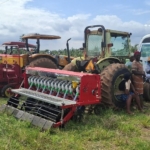
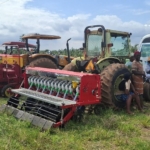
The Ghana Rice Production Improvement Project (GRIP), executed under the framework of technical cooperation by the Japan International Cooperation Agency (JICA) in partnership with the Directorate of Crop Services (DCS) and the Ghana Irrigation Development Authority (GIDA) of the Ministry of Food and Agriculture (MoFA), hosted a crucial field demonstration of labour-saving technologies.
The event aimed to strategically introduce rice stakeholders to advanced mechanisation to address the issue of high costs and labour shortages currently undermining the competitiveness of locally produced Ghanaian rice.

The Challenge of Competitiveness
Ghana currently imports approximately 950,000 tons of rice annually, with Asian varieties dominating the market due to cost efficiencies not yet matched by local producers.
Local rice farmers face significant hurdles, including rising machinery service fees for ploughing and harvesting, coupled with labour shortages as youth migrate to other sectors of the economy.
Heavy reliance on manual labour for key activities such as ploughing, seeding, fertilizing, harvesting and drying has resulted in high production costs, ultimately leading to local rice being priced similarly to, or even higher than, imported rice, frustrating both producers and consumers.
Strategic Introduction of Labour-Saving Technology
To overcome these constraints, GRIP championed the integration of modern, labour-saving mechanisation as a strategic measure to reduce production time and input costs.
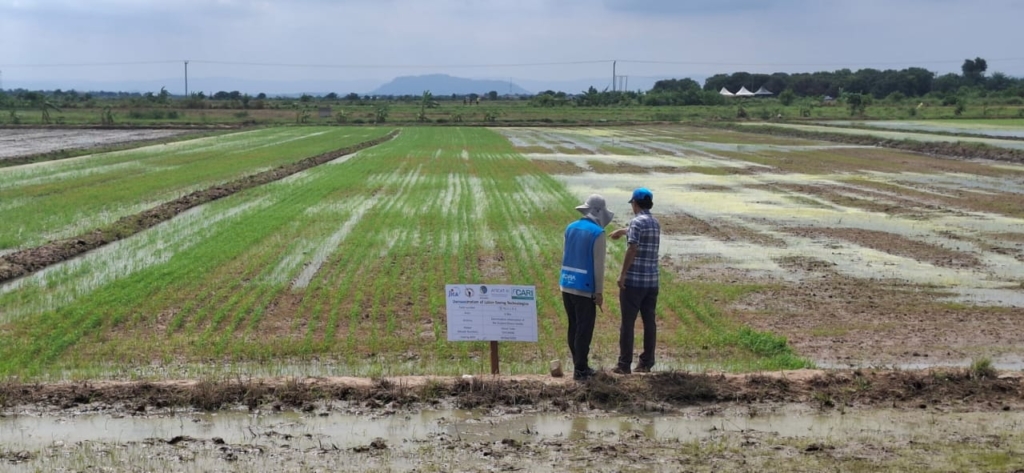
The field demonstration, co-organised by GRIP, Agricultural Engineering Services Directorate (AESD) of MoFA and the GIZ-supported Market-Oriented Value Chains for Jobs and Growth in the ECOWAS Region (MOVE) offered agricultural institutions, service providers and rice producers a firsthand opportunity to evaluate the practicality and economic viability of innovative equipment.
The equipment introduced to the participants consists of dry-field direct seeders, no-till dry-field direct seeders,
wet-field direct seeders, drone seeders, and drive harrows.
The equipment will help simplify the process of land development and reduce intensive land preparation, improve puddling operations and soil levelling in comparison to conventional methods, shorten manual labour operations and finally enhance post-harvest efficiency to improve rice quality.

In addition, GRIP also introduced a flat-bed paddy dryer, designed by International Rice Research Institute (IRRI) and fabricated by a local manufacturer of Ghana, as a labour- and time-saving alternative to the current conventional use of outdoor flat floor for drying paddy after harvest.
Fostering Adoption and New Business Models
The event went beyond mere showcasing. Machinery manufacturers and dealers presented their equipment and exhibited their labour-saving technologies, fostering direct engagement with agricultural machinery service providers and farmers. This collaboration was designed to enhance technical reliability, promote dissemination, and facilitate the development of new service-provider business models that make these technologies accessible across rice-growing areas.
The demonstration took place at the collaborating farmers’ fields at Kpong Irrigation Scheme (KIS) and was for all stakeholders committed to securing Ghana’s rice self-sufficiency.
- President Commissions 36.5 Million Dollars Hospital In The Tain District
- You Will Not Go Free For Killing An Hard Working MP – Akufo-Addo To MP’s Killer
- I Will Lead You To Victory – Ato Forson Assures NDC Supporters
Visit Our Social Media for More
About Author