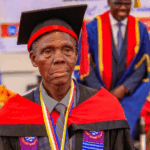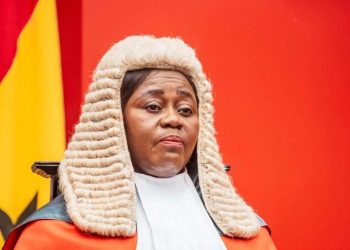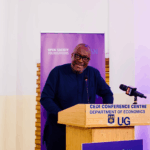
Prof Henry Kwasi Prempeh, the chairman of the Constitution Review Committee, says excessive presidential control has weakened the Council of State and undermined its original purpose as an independent advisory body.
Speaking on Joy News on December 25, Prof Prempeh rejected calls to abolish the Council of State, arguing that Ghana’s deeply polarised politics make the institution necessary.
He said, “We run a very polarised politics and every now and then you need some institution in the middle.”
He described the Council of State as a unique constitutional innovation rooted in Ghana’s traditional system of governance.
“It would be sad that the only thing we’re going to throw away is the one institution that we think looks authentically Ghanaian,” he said.
Prof Prempeh acknowledged widespread public dissatisfaction with the Council. He said evidence gathered by the committee showed concerns about its independence, composition and relevance.
“The people said, it is not sufficiently independent, it’s bringing the same people from the same party, it’s not diverse enough politically,” he said.
He also pointed to concerns about transparency. “What they do, we don’t know,” he said, describing the body as opaque.
Rather than scrapping it, Prof Prempeh said the solution lies in reform. “So fix it,” he said. “There is a problem with the Council of State, so you have to fix it.”
He explained that the proposed reforms aim to reduce presidential dominance. “We have changed it so that the President’s men and women don’t dominate it,” he said.
He said membership would be diversified to allow ideas to come from different sectors. Prof Prempeh said bodies such as the Academy of Arts and Sciences, the Trades Union Congress, the Ghana Association of Industries, the Chamber of Commerce and the National Chief Farmer should have representation.
According to him, this diversity would restore balance in a political system driven by two dominant parties. “The two-party system tends to drive even brilliant minds from coming in,” he said.
Prof Prempeh said the committee also looked at strengthening the Council’s role in key national decisions. He said for some functions, especially recruitment, the Council’s advice should be binding.
Where the advice is not binding, he said the Council should still play a meaningful role. “Let them have a chance for you to reconsider,” he said.
He explained that the Council should review major international agreements and natural resource deals for a second look. He cited agreements like the lithium deal as examples.
Prof Prempeh said the intention is not to give the Council veto powers, but to deepen reflection and caution in decision-making.
He insisted that the goal is restoration, not replacement. “We were looking for solutions, not just to abolish institutions,” he said.
According to him, the proposed reforms would return the Council of State to its original idea, drawn from Ghana’s traditional council of elders.
He said a reformed Council could become a model. “This is something that can work,” he said, adding that Ghana could then showcase how a traditional concept can function effectively within a modern constitutional system.
- President Commissions 36.5 Million Dollars Hospital In The Tain District
- You Will Not Go Free For Killing An Hard Working MP – Akufo-Addo To MP’s Killer
- I Will Lead You To Victory – Ato Forson Assures NDC Supporters
Visit Our Social Media for More
About Author