An empirical assessment of fiscal discipline, debt sustainability, and the case for a binding borrowing framework
ACCRA — Finance Minister Dr Cassiel Ato Forson has announced that government is preparing to introduce a new Loans Act aimed at tightening controls on public borrowing and ensuring that all debt contracted delivers measurable value to the economy. The proposed legislation will strictly define the permissible uses of borrowed funds, with a clear requirement that every loan be linked to high-impact, value-for-money investments.
The timing is not accidental. Ghana is emerging from its worst economic crisis in a generation — a sovereign default in 2022, a painful debt restructuring, and a US$3 billion IMF Extended Credit Facility programme that has, by most accounts, put the country back on a path toward stability. Public debt, which peaked at 79.1 per cent of GDP in 2023, is projected to fall below 50 per cent by 2030 under the IMF programme framework.
The question this article addresses is straightforward: does the empirical evidence support the case for a legislative borrowing constraint? Drawing on World Bank data for ten African countries, the IMF’s own programme documents, and a battery of econometric tests, we find that the answer is a qualified yes — but with important caveats about design and enforcement.
The debt trajectory that made the Loans Act necessary
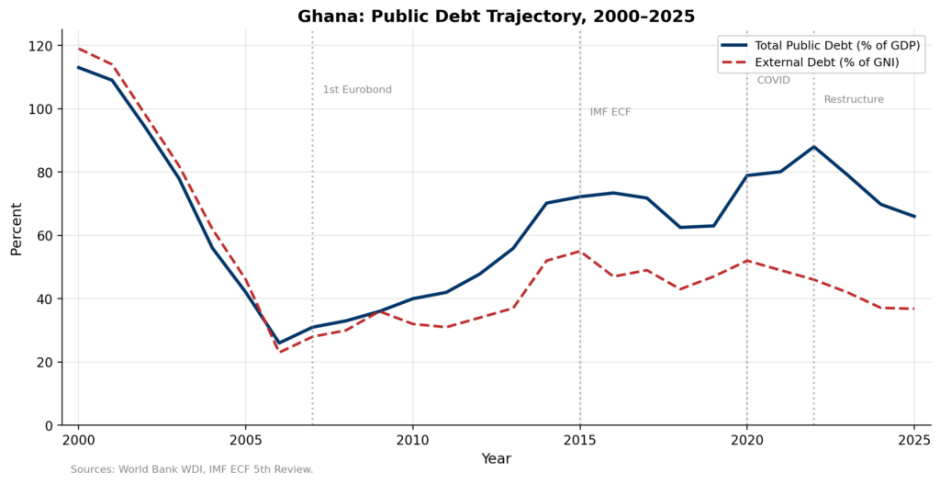
Understanding why Ghana needs a Loans Act requires understanding how it arrived at crisis. The chart below tells the story. Ghana’s public debt-to-GDP ratio fell from 113 per cent in 2000 to a remarkable low of 26 per cent in 2006, benefiting from HIPC debt relief. What followed was a dramatic reversal.
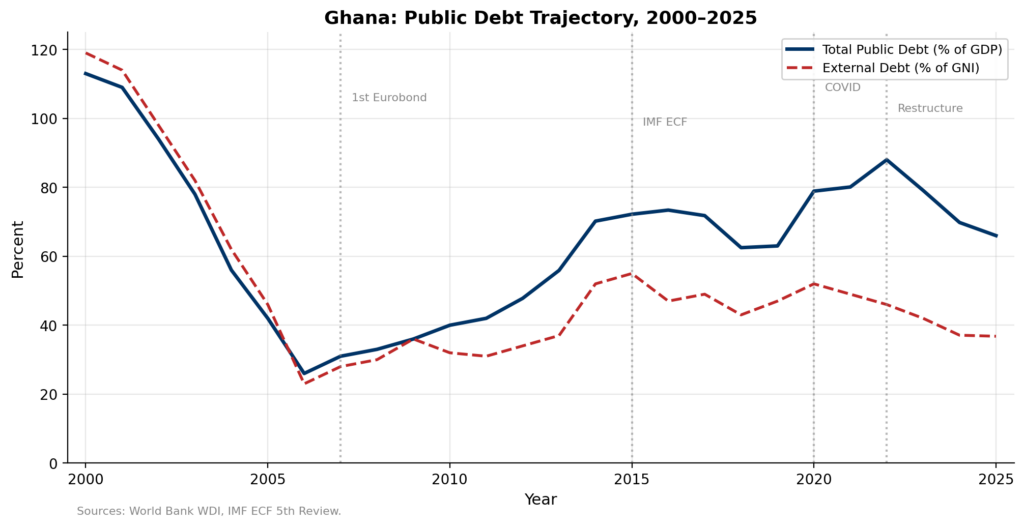
Figure 1: Ghana’s public debt trajectory, 2000–2025. Vertical lines mark key policy events. Sources: World Bank WDI, IMF.
The 2007 Eurobond issuance opened access to international capital markets. Between 2006 and 2023, debt tripled from 26 to 79 per cent of GDP. The drivers were chronic fiscal deficits, energy sector bailouts, an expanding wage bill, and — crucially — the absence of any legal constraint on borrowing purpose or volume. Ghana’s Public Financial Management Act (2016) envisaged sanctions for fiscal misconduct, but it did not establish binding debt limits or require borrowing to be tied to productive investments.
Ghana’s experience is not unique among African peers, but it is among the most dramatic. The chart below compares Ghana’s debt path to those of Kenya, Senegal, Côte d’Ivoire, Zambia, and Nigeria. Ghana’s accumulation was faster and steeper than all but Zambia, which also defaulted.
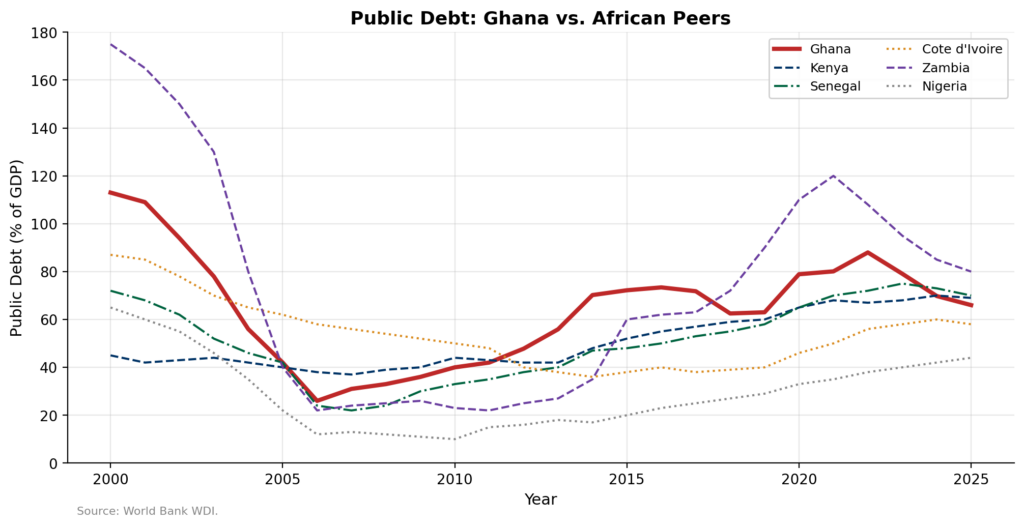
Figure 2: Public debt trajectories — Ghana vs African peers, 2000–2025. Source: World Bank WDI.
What the IMF programme has achieved
The IMF’s 5th ECF Review, completed in December 2025, paints an encouraging picture. Growth exceeded expectations at 5.7 per cent in 2024. Inflation has fallen back within the Bank of Ghana’s target band. International reserves, which stood at a perilous 1.6 months of import cover in 2023, have risen to 3.3 months and are projected to reach 4.1 months by 2030. Most importantly, Ghana achieved a primary fiscal surplus of 1.5 per cent of GDP in 2025 — its first in several years.
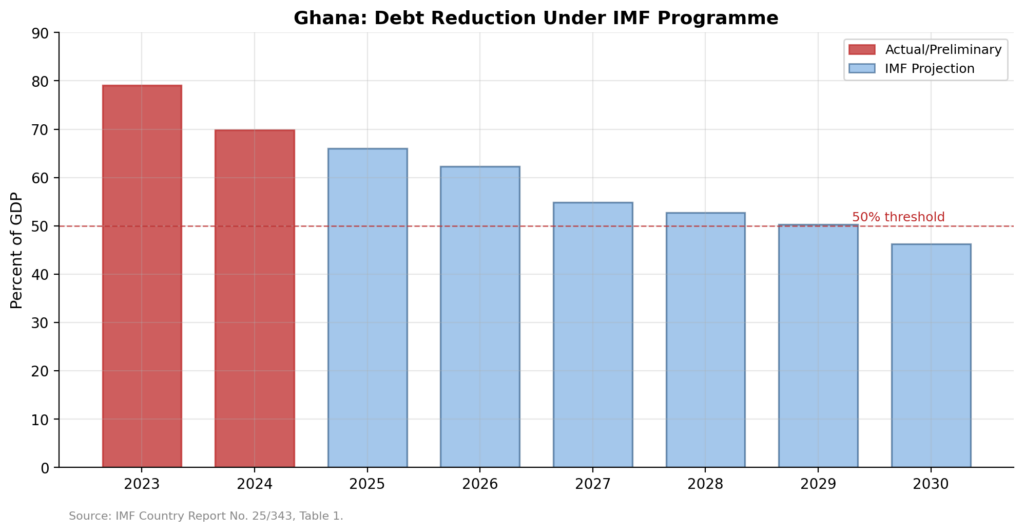
Figure 3: Debt reduction under the IMF programme — actuals (red) and projections (blue). Source: IMF Country Report No. 25/343.
The programme targets public debt falling to 46.3 per cent of GDP by 2030. Revenue is projected to rise from 15.2 to 17.0 per cent of GDP, driven by tax administration reforms and the VAT restructuring. Capital expenditure is set to increase from 2.3 to 3.4 per cent of GDP, while interest payments gradually decline from 4.3 to 3.5 per cent.
Key economic indicators at a glance
| Indicator | 2023 | 2024 | 2025 | 2027 | 2030 | Target |
| Real GDP growth (%) | 3.1 | 5.7 | 4.0 | 4.8 | 5.0 | ≥5.0 |
| Inflation, avg (%) | 39.2 | 22.9 | 17.3 | 7.9 | 8.0 | 8±2 |
| Revenue (% GDP) | 15.2 | 15.9 | 15.9 | 16.8 | 17.0 | ≥17 |
| Primary balance (% GDP) | −0.3 | −2.3 | 1.5 | 1.5 | 1.0 | ≥1.0 |
| Public debt (% GDP) | 79.1 | 69.8 | 66.0 | 54.9 | 46.3 | <50 |
| Reserves (months) | 1.6 | 2.6 | 3.3 | 3.4 | 4.1 | ≥3.0 |
Table 1: Selected indicators from IMF ECF 5th Review. Source: IMF Country Report No. 25/343.
These numbers are impressive. One data point, however, warrants closer attention: the primary balance deteriorated sharply to −2.3 per cent of GDP in 2024, against −0.3 per cent in 2023. Ghana’s December 2024 general election offers the most plausible explanation — election-year fiscal slippage is a well-documented pattern in the country’s fiscal history, driven by spending surges and revenue shortfalls in the run-up to polling day. The subsequent rebound to a surplus of 1.5 per cent in 2025 is encouraging, but it is also instructive: it demonstrates that fiscal discipline can be restored, yet equally that it can be abandoned the moment political incentives push in the other direction. Far from undermining the case for the Loans Act, this episode strengthens it. A legally binding framework is most valuable precisely when electoral pressures make fiscal restraint politically costly. But they are conditional on sustained policy discipline over the next five years — through at least one election cycle. Herein lies the problem. IMF conditionality is temporary. The ECF programme will end. What happens then?
The evidence on fiscal discipline
We tested whether Ghana’s fiscal performance systematically differs between IMF programme and non-programme years, using data from 2000 to 2025. The results are suggestive. The average fiscal balance was −2.9 per cent of GDP during programme years, compared to −4.4 per cent in non-programme years — an improvement of 1.5 percentage points. The difference is marginally significant at the 10 per cent level (p = 0.107).
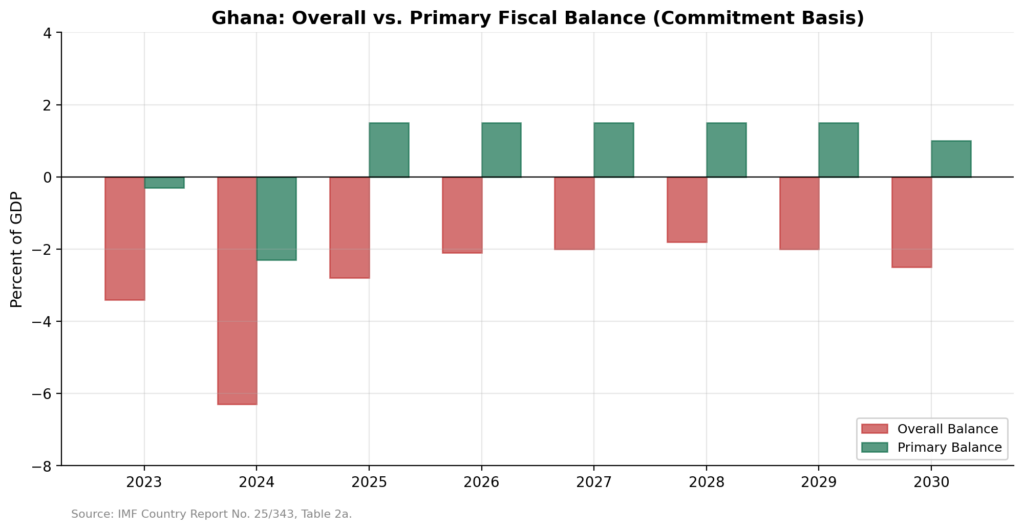
Figure 4: Overall vs primary fiscal balance under the ECF programme, 2023–2030. Source: IMF.
This is not a trivial finding. It suggests that external discipline — the requirement to meet quantitative performance criteria, the regular reviews, the threat of programme suspension — does improve fiscal outcomes. But the improvement is modest, and crucially, it is not permanent. Once conditionality lapses, Ghana has historically reverted to deficit spending. The 2020–2022 experience is instructive: within four years of the previous ECF programme ending, Ghana was in sovereign default.
This is the core economic rationale for the Loans Act. If a domestic legal framework can replicate even a fraction of the disciplining effect of IMF conditionality — and do so permanently — it would represent a significant improvement in Ghana’s fiscal architecture.
Where does the money go?
A deeper concern is not merely how much Ghana borrows, but what it borrows for. The expenditure composition data from the IMF staff report reveals a troubling pattern.
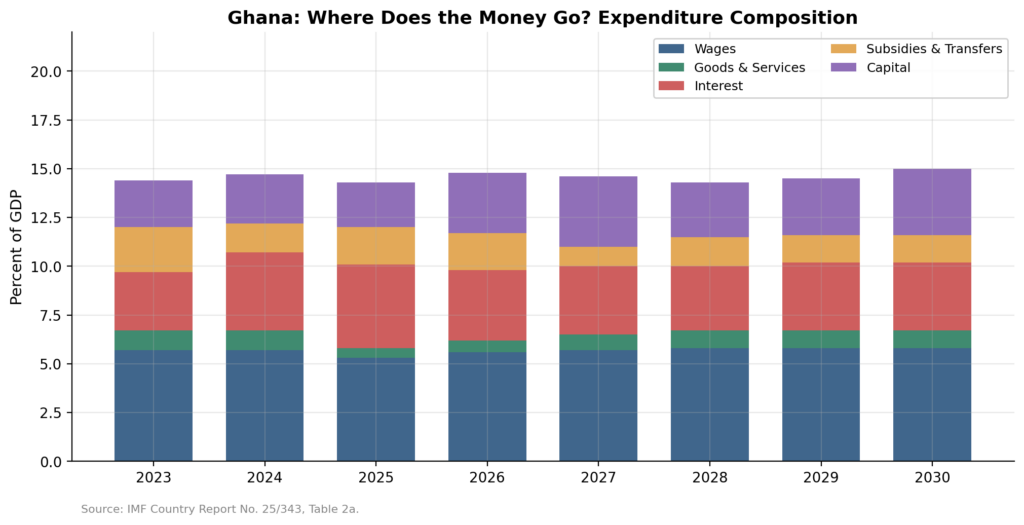
Figure 5: Expenditure composition — where does the money go? Source: IMF Country Report No. 25/343, Table 2a.
In 2025, interest payments consumed 4.3 per cent of GDP — nearly twice the 2.3 per cent allocated to capital expenditure. The wage bill, at 5.3–5.7 per cent of GDP, is the single largest spending category. For every cedi the government invests in infrastructure, schools, or hospitals, it spends approximately GH¢1.87 on debt service.
We tested econometrically whether expenditure composition matters for growth. Using a time-series regression for Ghana (2000–2024), neither capital expenditure nor recurrent expenditure showed a statistically significant positive effect on GDP growth. A VAR model confirmed that debt does not Granger-cause growth (p = 0.39). In plain language: Ghana’s borrowing over the past two decades has not been productively channelled.
This finding directly supports the Loans Act’s central proposition — that every loan must be linked to “high-impact, value-for-money investments.” The evidence suggests that without such a requirement, borrowing drifts toward recurrent expenditure and debt service, creating a self-reinforcing cycle of fiscal deterioration.
Reserves: rebuilding the buffer
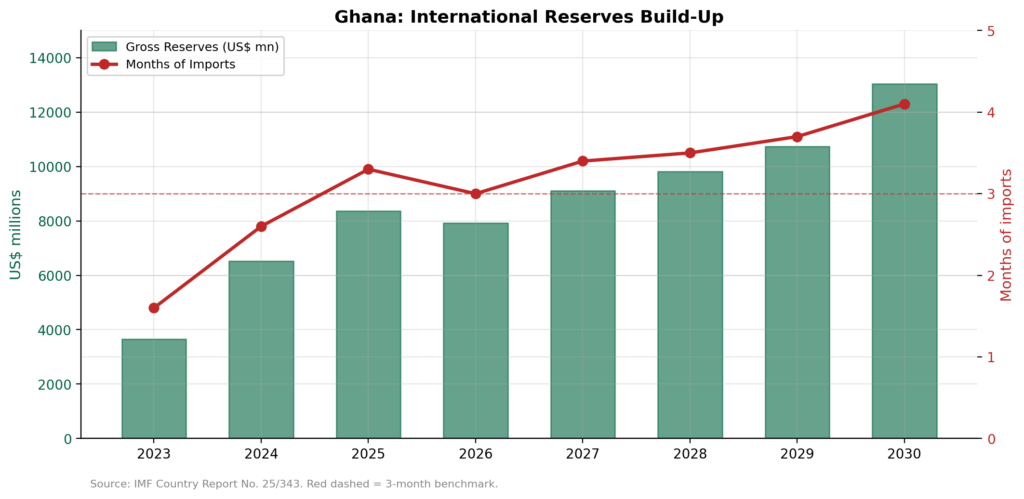
Figure 6: International reserves build-up. Red dashed line = 3-month adequacy benchmark. Source: IMF.
One of the programme’s notable achievements is the rebuilding of international reserves. From a dangerously low 1.6 months of imports in 2023, reserves are projected to exceed 4 months by 2030. This buffer provides critical insulation against external shocks. The Loans Act should include provisions that prevent drawdowns on reserves to finance fiscal deficits — a practice that contributed to the 2022 crisis.
Cross-country evidence: do fiscal rules work?
Using a panel of ten African countries (2000–2025), we estimated fixed-effects regressions to test whether countries with fiscal rules in place — such as Kenya’s Public Finance Management Act, Nigeria’s Fiscal Responsibility Act, or the WAEMU convergence criteria binding on Senegal and Côte d’Ivoire — experience lower debt levels. The results were mixed. The fiscal rule dummy was absorbed by country fixed effects in some specifications, reflecting the fact that countries like Senegal have had rules in place for the entire sample period.
However, the fiscal balance emerged as the most robust and significant determinant of debt dynamics across all model specifications (p < 0.05 in all three models). Every one-percentage-point improvement in the fiscal balance was associated with a 2.4–3.0 percentage point reduction in the debt-to-GDP ratio. This is a powerful result: it tells us that what matters most is not the label “fiscal rule” but the actual fiscal discipline it produces.
A unit root test confirmed that Ghana’s debt follows a non-stationary process — meaning it drifts without converging to any target. An Engle–Granger cointegration test found only borderline evidence of a long-run equilibrium between debt and growth (p = 0.058). The policy implication is stark: without a structural anchor such as the Loans Act, debt will continue to follow a random walk rather than converge to a sustainable level.
Design principles: making the law bite
International experience teaches us that fiscal rules succeed or fail not on their statutory elegance but on their enforcement architecture. Brazil’s Fiscal Responsibility Law (2000) significantly reduced subnational debt but has been circumvented at the federal level through creative accounting. Kenya’s PFM Act set debt ceilings that proved too generous and weakly enforced. The EU’s Stability and Growth Pact was routinely violated by its largest members without consequence.
Chile’s structural balance rule — widely regarded as the gold standard — succeeded because it was backed by an independent fiscal council, transparent methodology, and broad political consensus. Ghana should draw from this model.
Based on our empirical findings, we recommend that the Loans Act incorporate the following elements:
First, a legislated debt ceiling. Our analysis suggests that debt-to-GDP above current levels is associated with lower growth. A ceiling of 55–60 per cent of GDP, with an amber warning at 50 per cent, would provide a meaningful constraint while allowing space for development borrowing.
Second, a primary balance floor. The IMF programme targets a primary surplus of at least 1.0 per cent of GDP. The Loans Act should enshrine this as a minimum, ensuring fiscal space for debt reduction even after the programme ends.
Third, a borrowing purpose test. Every loan — domestic and external — should be tied to a capital project with a published cost–benefit analysis. This directly addresses the finding that Ghana’s borrowing has not been productively channelled.
Fourth, an escape clause with automatic sunset. Severe economic shocks (e.g., a GDP contraction exceeding 3 per cent) should allow temporary suspension of the debt ceiling, but with automatic reinstatement after two years. This prevents the law from becoming a straitjacket during crises while preserving discipline in normal times.
Fifth, independent oversight. The law should establish or empower a fiscal council with statutory authority to monitor compliance, publish assessments, and flag deviations. Without independent enforcement, the law risks becoming another well-intentioned but toothless statute.
Conclusion
Ghana stands at a crossroads. The post-restructuring recovery is real, the IMF programme is delivering results, and the macroeconomic fundamentals are improving. But this window of opportunity will not last indefinitely. The proposed Loans Act addresses a genuine structural gap in Ghana’s fiscal architecture — the absence of a binding legal framework to constrain borrowing.
Our empirical analysis, drawing on 25 years of data, IMF programme documents, and cross-country evidence, supports three conclusions. First, IMF conditionality improves fiscal discipline, but only temporarily — the effect fades when programmes end. Second, Ghana’s borrowing has not been productively channelled: neither capital nor recurrent expenditure significantly boosts growth, and debt does not Granger-cause growth. Third, the fiscal balance is the single most important determinant of debt sustainability, and without a structural anchor, Ghana’s debt will drift rather than converge.
The Loans Act can be that anchor. But legislation alone is not sufficient. Design and enforcement matter more than good intentions. Ghana must learn from the failures of fiscal rules elsewhere and invest in the institutional architecture — independent oversight, transparent reporting, credible sanctions — that makes the law more than words on a page.
The credibility window is open now. The time to act is before the next commodity boom, the next election-year spending spree, or the next global shock tests Ghana’s resolve. If the Loans Act is well designed and faithfully enforced, it could mark the beginning of a new chapter in Ghana’s fiscal history. If not, we may find ourselves reading a familiar story in a few years’ time.
About the Author
Dr Stephen Lartey is a development economist with a PhD in Economics specialising in institutions, fiscal policy, monetary and macroeconomic policy, and causal inference. The author can be reached at [email protected]

Data Sources & Methodology
This analysis uses World Bank WDI data for 10 African countries (2000–2025) pulled via the wbopendata API, IMF ECF 5th Review data (Country Report No. 25/343, December 2025), and Worldwide Governance Indicators. Econometric methods include panel fixed/random effects regressions, Vector Autoregression with impulse response functions, Granger causality tests, Fisher panel unit root tests, and Engle–Granger cointegration tests. The full replication code (Stata .do file) is available from the author.
- President Commissions 36.5 Million Dollars Hospital In The Tain District
- You Will Not Go Free For Killing An Hard Working MP – Akufo-Addo To MP’s Killer
- I Will Lead You To Victory – Ato Forson Assures NDC Supporters
Visit Our Social Media for More
About Author