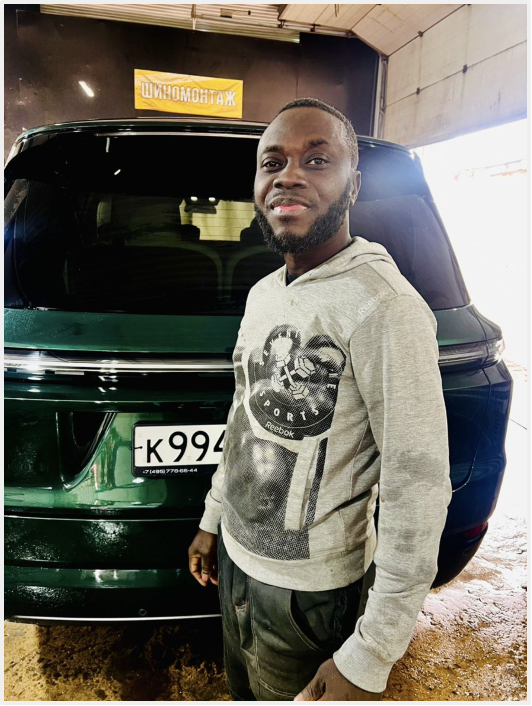
Kwasi Oppong (not his real name) is overwhelmed with grief after he reflects on the worst nightmare he has encountered since he signed up to fight for Russia in its special military operation against Ukraine.
“We have seen death, dead bodies, blood, what else again, but it was my decision to fight in this war.”
Unlike many Africans who joined the war for economic reasons, he joined the military expedition out of conviction. “No one forced me. I joined the war because of my idea of communism and my advocacy for Pan-Africanism,” he said.
But this wasn’t the case for many Africans he had seen die in the war. They were sold hope as opportunities in a web that’s controlled by Ghanaian travel agents, Russian intermediaries and individuals with military backgrounds.
Kwasi’s account reveals a complex web of risk, language barriers, ideological beliefs, recruitment agents and survival instincts that shaped the journey of many African volunteers.
His experience differs from that of Edwin Akrasi Tanoh, who had apparently left Ghana for Russia in November 2024 to further his education. Little did the family know he would end up in Russia’s special military operation.
“He never mentioned anything to anybody that he was going to fight,” said Harriet Akrasi Junior, his junior sister.
Edwin Akrasi Tanoh, a dark, well-built man in his early thirties, concealed his intention. But, according to Harriet, the family was not in support of his idea of migrating to Russia when it was actively engaged in war with Ukraine.
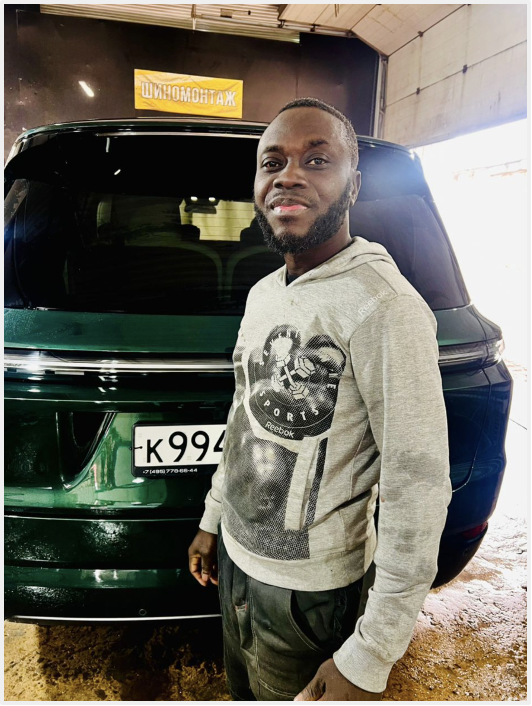
She recounted that her brother persuaded them, saying he had secured a scholarship to study. They did not know whether his trip was facilitated by a travel agent or an intermediary in Russia.
She added that, when he initially arrived, Edwin used to call them to enquire how they were doing. However, the last time they heard from him was May 2025.
“The last time I heard from him was when he wished me a happy birthday,” she sadly recalled.
Harriet said the family is uncertain whether he is alive or dead. “Everybody is troubled. We have all been finding ways and means to connect with him.”
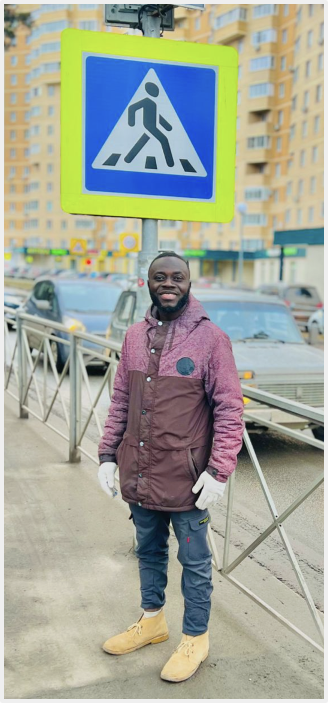
Harriet’s family is not the only one in this dilemma. Ransford Yeboah’s 24-year-old brother, Isaac Asumah Fiifi Humphrey, also left the shores of Ghana in November 2025 with two others to study in Russia.
But they later heard he had dropped out of the university to join the army.
“We tried contacting him, trying to check up on him, but it was not going through. We received a phone call from someone in Russia who indicated my brother had told him to call my mom to tell her he had joined the army.”
Ransford recounted that when he called one of the townsfolk who travelled with him to Russia, the man explained that Asumah had not given reasons for his decision to join the army. He had been discreet about it to the point of concealing it from the family.
“A different person in our home town contacted him. He didn’t want us to know he was in the army. Because if we knew, my mom would call him and try to talk him out of it. So that was the reason he never wanted to pick up our calls,” he added.
He says the family, especially his mother, is broken. They do not know whether he is dead or alive. “The family feels sad. At night, my mom will go into her room and sit on the bed, thinking. If you ask her why, she would say she has still not heard from her son.”
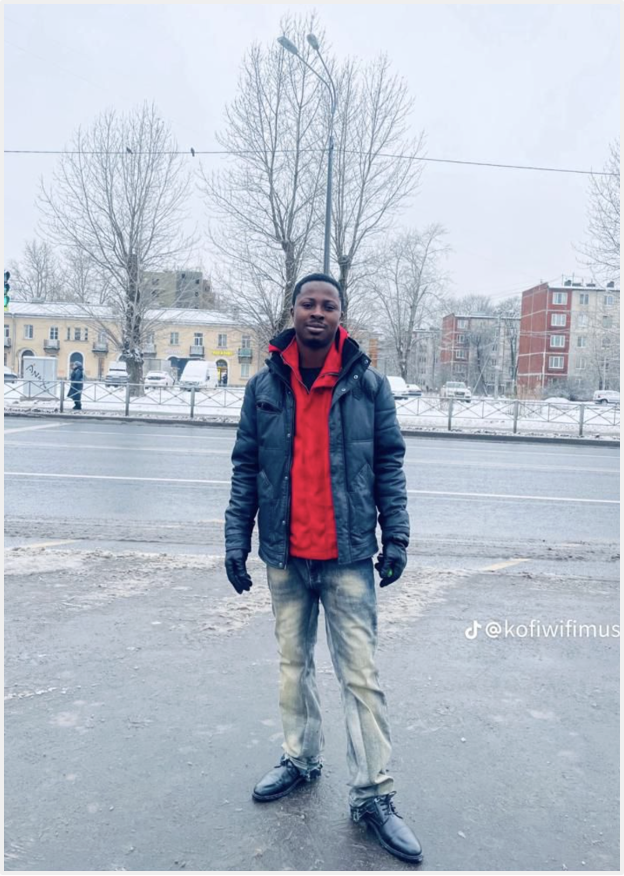
In September 2024, TV3 reported that 14 Ghanaian men were caught in the Russia-Ukraine war after they were lured with the promise of better opportunities. What promised to be a door of opportunity became one of gloom.
According to intelligence shared by Ukraine Foreign Minister Andrii Sybiha when he met Ghana’s Foreign Minister, 272 Ghanaians have been lured into the conflict since 2022 through transnational criminal trafficking networks. Broader data shared during the engagement revealed that 1,780 Africans from 36 countries are believed to have been recruited under similar circumstances to fight against Ukraine.
At least 55 Ghanaians have been killed fighting in the war in Ukraine, with two others currently being held as prisoners of war, according to Foreign Affairs Minister Samuel Okudzeto Ablakwa. This coincides with a 2026 report published by INPACT, which further indicates that 316 African recruits have so far been killed in the war.
Russian authorities have denied involvement in the illegal recruitment of African citizens to fight in the armed forces.
Recruitment and the role of agents
The recruitment trail usually starts in Ghana, where travel agents advertise high-paying jobs on social media channels, promising work permits.
According to Kwasi, who is still fighting in the Russia–Ukraine War, many travel agents lure unsuspecting Ghanaians with the promise of jobs that pay between $3,000 and $3,500 in Russia. However, the only jobs that pay that much are often those tied to the war.
The agents charge desperate Ghanaians between $4,000 and $4,500 to process travel documents and cover related expenses.
“Travelling agents are lying to innocent Ghanaians. They charge between GHc45,000 and 50,000 cedis. Out of frustration with the country’s economy, they fly to Russia and join the Army. But, soon they realise they have been deceived,” Kwasi said.
He and two of his friends were linked to Russian intermediaries by persons working in the Ghanaian army after paying $200 each.
The channels and routes used
JOYNEWS checks reveal that, aside from social media channels like TikTok that the local agents use to entice unsuspecting Ghanaians, pro-Russia influencers on Facebook also invite followers to join the Russian army for good benefits.
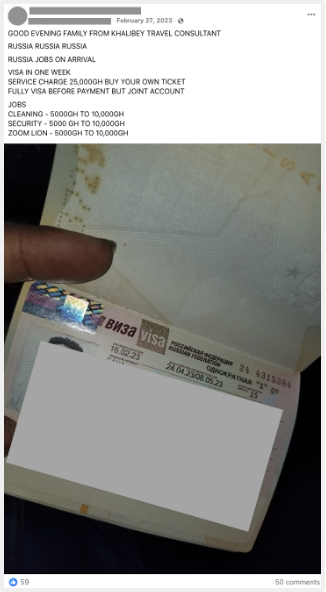
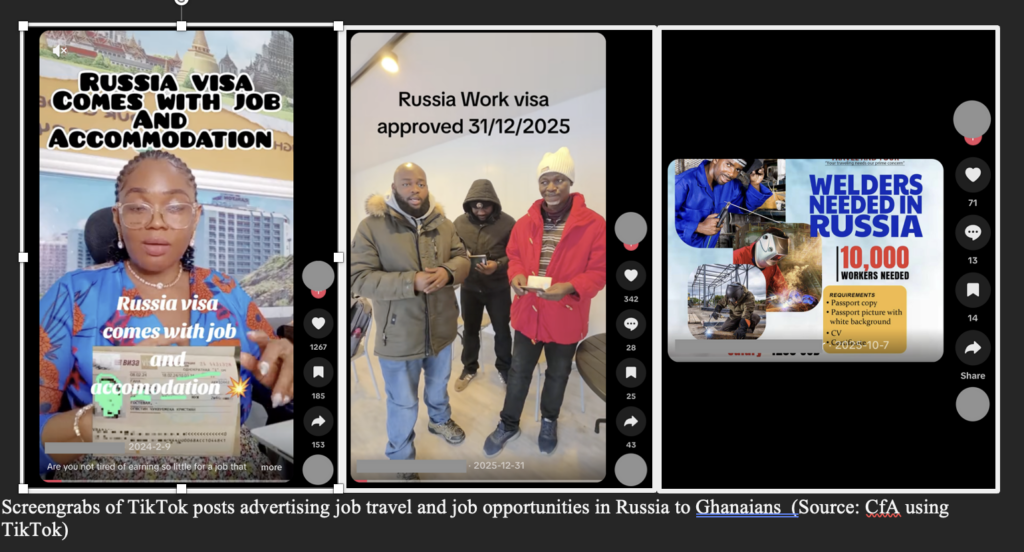
At least 23 (1, 2, 3) TikTok accounts actively post advertisements calling on people interested in working in Russia to contact them.
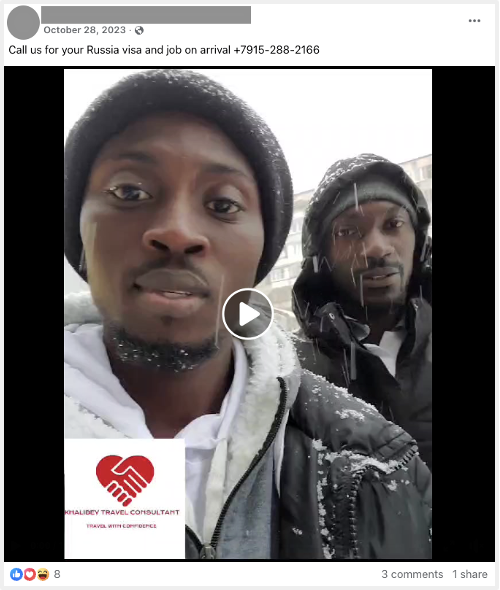
Whilst some of these advertisements are for normal jobs like drivers, bartenders, and factory hands, others clearly state that the recruitment is for the Russian army. At least 11 (1, 2, 3) of these pages appear to be managed by Ghanaian nationals and are specifically targeted at the Ghanaian audience.
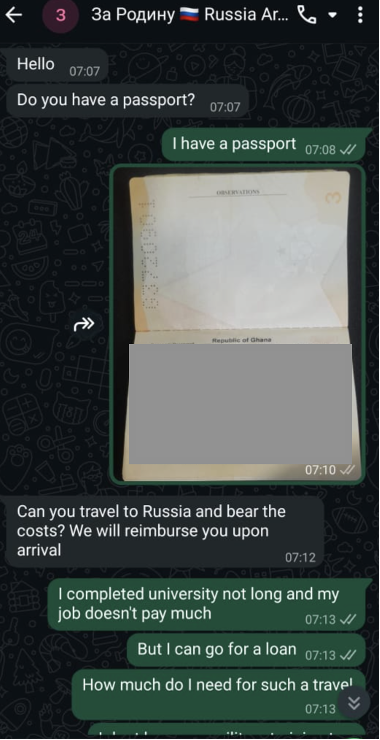
Posing as a Ghanaian interested in travelling to Russia, the team contacted Richie, a known agent based in Russia, who is reportedly responsible for facilitating travel for desperate Ghanaians to join the Russian army.
He indicated that the only current opportunity is construction work in Belarus, which shares a border with Russia.
The agents’ mode of operation is to offer juicy jobs, but provide unsuspecting Ghanaians with tourist visas, which compels them to accept irregular contracts to join the army once the visas expire and the victims become desperate.
Richie explained that I would have to pay GHc35,000 cedis ($3,200) to enable him to process a visa and secure accommodation and a working permit for me. He added that I would have to submit my passport and medical examination form and make a partial payment into the bank account he provided before he would process the documents.
Kwasi avoided these agents. After he was connected to a Russian intermediary, he went through Qatar to Russia to begin his military service.
“I joined with a friend from Qatar, but it’s been God who has been with us since day one. I will not advise anyone to take the risk I took, and I will not do such a thing again in my entire life.”
Kwasi’s case brings up a new approach. There are recruitment drives targeting the African diaspora. We tracked a TikTok account that specifically called on Ghanaians living in the Gulf region interested in working in Russia to reach out.
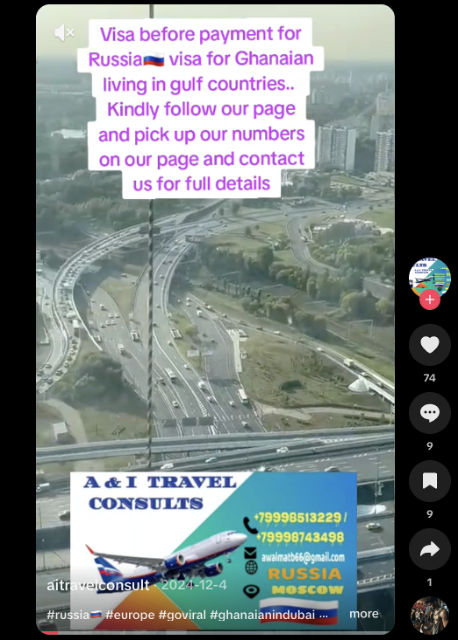
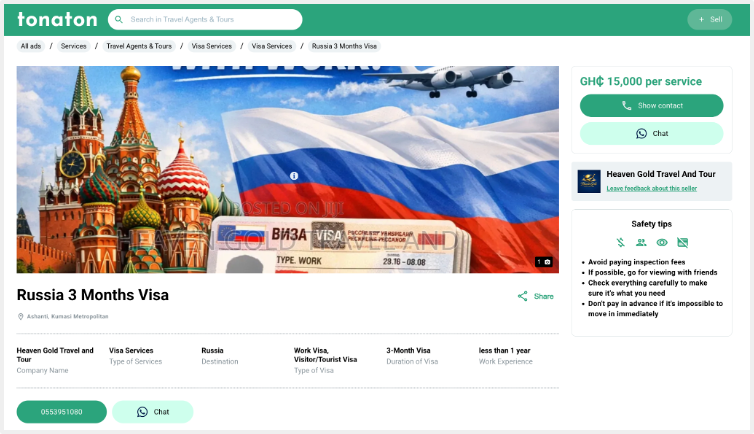
Beyond its TikTok account, one of the travel agencies at the centre of this recruitment drive, called ‘Heaven Gold Travel And Tour’, advertises on online marketplaces such as Jiji and Tonaton.
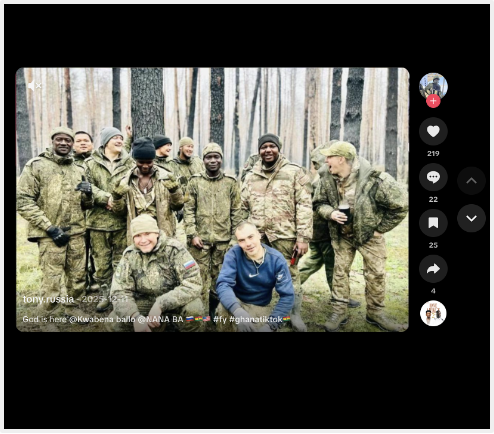
We also identified at least two TikTok accounts (1, 2) belonging to persons who purport to be fighting for the Russian army in the war.
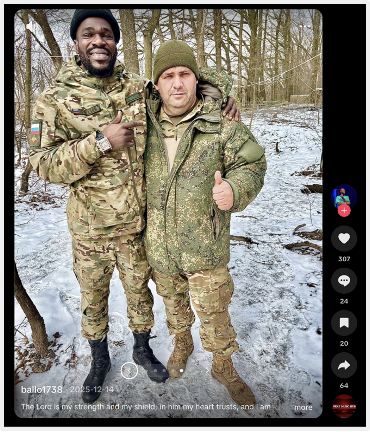
The accounts glamorise being on the front lines in their posts, receiving several comments from other TikTok users who express interest in joining the Russian army and ask for details on how to do so. A few comments express scepticism about fighting in the war, emphasising the risk involved.
Language barriers and arrival reality
The exploitation starts the very moment the contracts are placed before them. According to Kwasi, the contracts are written in Russian. Many individuals signed these contracts without any idea what they were getting into.
“Those who can’t translate the sign as soon as they are given the paper.”
“I am educated, so I have time to translate everything on paper before signing. I came with two friends, and by God’s grace, we are all alive. We signed on the same date, and we are done with our contract, waiting to be released.”
Kwasi describes as inaccurate claims by the Russian government that it is not involved in the illegal recruitment of Africans to fight in its special military exercise because of the nature of the contracts signed. “They lied to them that you’re not going to combat, but you will end up at the frontline.”
According to him, what has saved him is his insistence on his role as a volunteer to any commander. What he does is either join the teams to conduct evacuations, build bombs, or deliver supplies.
Even this has not insulated him from the risks of war. He has learnt to adapt to trauma by becoming emotionally numb to the realities.
“I faced so many deadly situations with my friends, drone attacks, rocket attacks, stepping on a mine which was set as a trap, but nothing happened to us; only God helped us.”
The risks are exacerbated based on the level of training one receives. He was fortunate to have received two months of training, but others were barely trained for three weeks before their deployment to the battlefield.
The bad end of the deal
President of the Ghanaian Community in Russia, Ebenezer Wepari, corroborated Kwasi’s claims. He said he is aware of some Ghanaians who have signed up to fight in Russia’s special military exercise against Ukraine. Many Ghanaians who join the army are enticed by benefits, including the opportunity of receiving Russian citizenship, cash compensation, and so on.
He revealed that many of these Ghanaian soldiers are having challenges because they were lured to sign irregular contracts by agents who facilitated their travel to Russia.
He explained that many of these Ghanaians sign the contracts without fully understanding the terms and conditions, mainly due to the language barrier.
He added that, as a result, many of these Ghanaians have been given the bad end of the deal they were assented to.
Wepari revealed that some agents lure these Ghanaian recruits to share sensitive details, including their bank accounts and end up syphoning the funds paid to them.
He also observed that some of these agents lure their clients into paying exorbitant fees for the visa processing and other related travel expenses.
“But from the accounts of some of the people who come, they feel disappointed about the conditions for even agreeing to travel. This is because they are unaware of what they’re signing.
“And that’s because sometimes the agents tell them that, oh no, you’re coming to do delivery work, warehouse jobs and other jobs. And in the end, they end up in such situations.”
He disclosed that some Ghanaian soldiers have died in the war, yet their families are unable to access their compensation. “Some of them, we don’t even have their passport details, not to talk of their contract. So without that, there is literally nothing you can do.”
He recounted that recently, some families had called on him to help them access the benefits of their kin, but the recruit had not shared his contract with them. He said this is because the agents deceive recruits into not revealing these details to their families.
Wepari is also aware of a few Ghanaians who have completed their contracts with the Russian army and are currently living in the Federation, with all the documents promised intact.
Sources at the anti-human trafficking unit of the police service confirmed they are currently investigating a case of some Ghanaians lured to travel and fight in a Russian special military exercise.
Ghana’s Foreign Affairs Minister, Samuel Okudzeto Ablakwa, in his February meeting with Ukraine’s President, Volodymyr Zelenskyy, said that many Africans fighting for Russia were deceived through dark web platforms with promises of lucrative employment opportunities.
“They have no security background. They have no military background. They have not been trained,” Ablakwa said. “They were just lured and deceived and then put on the front lines.”
He also appealed to the Ukrainian government to release two Ghanaians who were captured for fighting for Russia, as reported by Al Jazeera.
Mr Ablakwa said Ghana intends to use its upcoming African Union presidency next year to spotlight trafficking networks that use deception to recruit fighters for the Russian military.
President Zelenskyy on his X account said he had “detailed discussions” with the Ghanaian minister “on how Russia is recruiting citizens of Ghana and other African countries to take part in the war against Ukraine, and on how we can counter this”.
This article was produced with support from the African Academy for Open Source Investigations (AAOSI) and the African Digital Democracy Observatory (ADDO) as part of an initiative by Code for Africa (CfA). Visit https://disinfo.africa/ for more information.
- President Commissions 36.5 Million Dollars Hospital In The Tain District
- You Will Not Go Free For Killing An Hard Working MP – Akufo-Addo To MP’s Killer
- I Will Lead You To Victory – Ato Forson Assures NDC Supporters
Visit Our Social Media for More
About Author