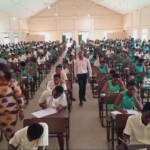
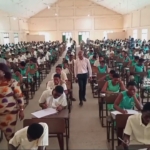
If you are a parent, teacher, or policymaker, the annual release of exam results brings a familiar sense of anxiety. For years, headlines have swung between “mass failure in mathematics” and “slight improvement,” leaving the public confused about the true state of our children’s education.
A careful analysis of performance in the Basic Education Certificate Examination (BECE) and the West African Senior School Certificate Examination (WASSCE) reveals not only a problem of poor grades but also a dangerous and persistent crack in the very foundation of mathematics learning, a direct threat to Ghana’s future.
Two Different Exams, One Alarming Story
First, it is crucial to recognise that BECE and WASSCE cannot be compared solely on pass percentages. The BECE, taken at the end of Junior High School, is a competitive examination for admission to Senior High School. A student’s grade depends on their performance relative to their peers (Norm-Referenced Interpretation). The WASSCE, however, is a standards-based exam that assesses whether a student has mastered the prescribed material for university entry (Criterion-Referenced Interpretation).
Yet when we track year-on-year performance, a clear and troubling pattern emerges. BECE mathematics performance is chronically unstable. Before the pandemic, BECE mathematics pass rates (Grades 1-6) typically ranged from 50% to 65%. In 2020/21, the average Junior High School (JHS) student scored 49% in mathematics, with a quarter of students scoring below 34%.
During the 2022-2024 academic years, performance improved. More telling are the chief examiners’ reports, which for years have cited the same fundamental weaknesses: an inability to solve basic word problems, a poor understanding of fractions and percentages, and difficulties with area and volume calculations.
These BECE weaknesses do not disappear; they persist. At the WASSCE level, persistent poor performance in core mathematics constitutes a national crisis. This foundational weakness matures into a full-blown crisis at the senior high level. For years, the percentage of WASSCE candidates obtaining a credit pass (A1-C6) in core mathematics—the essential ticket to university—has been consistently low, often languishing between 35% and 45% in the pre-2000 era.
The release of the 2025 WASSCE provisional results has sent shockwaves through the nation. For the first time in years, the “progress” narrative has been stripped away, revealing a catastrophic decline in core mathematics. The pass rate (A1–C6) declined from 66.86% in 2024 to 48.73% in 2025. Even more troubling is the surge in outright failure: the percentage of candidates receiving an F9 grade nearly quadrupled, rising from 6.10% to 26.77%. This means that, in a typical year, most Senior High School (SHS) graduates are excluded from tertiary education primarily because of their mathematics performance.
While some may view this as a sudden collapse, a deeper analysis suggests it is an “integrity-adjusted” reflection of a long-standing crisis. The 2025 exams saw an unprecedented crackdown on malpractice, with more than 7,000 candidates penalised and 19 teachers convicted of exam-related offences. This suggests that previous “gains” may have been a veneer masking a foundation that has been crumbling for a decade.
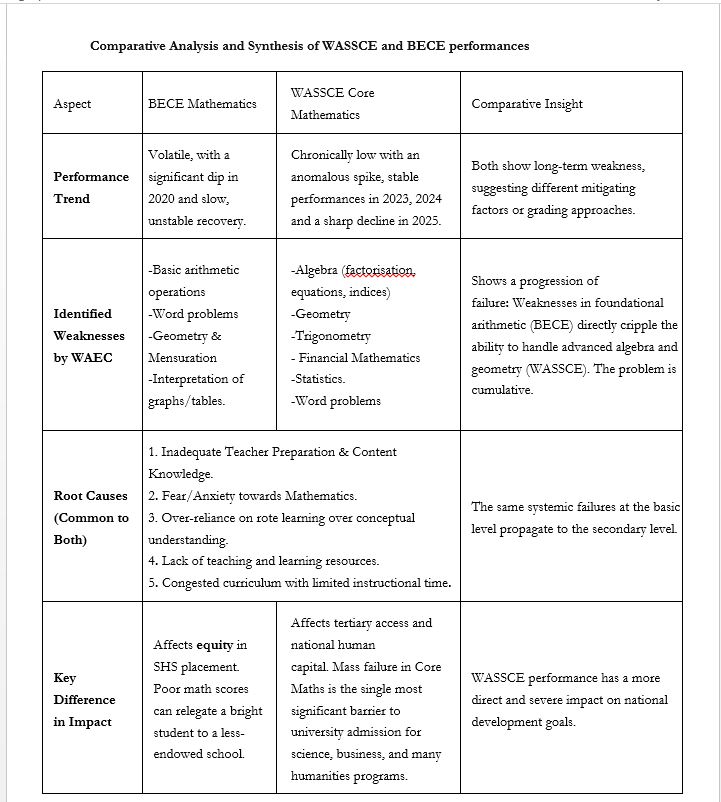
These two datasets are linked. The chronic struggles with basic arithmetic, fractions, and word problems cited in BECE chief examiners’ reports directly predict the catastrophic failure in WASSCE’s core mathematics. We are witnessing a system in which students are promoted despite fundamental deficits that cripple them at the next level.
The Seven Deadly Deficiencies
According to the 2025 Chief Examiners’ Report, the failure was not due to the difficulty of the topics but a fundamental inability to apply knowledge. WAEC officials identified seven critical skill gaps that students carried from JHS into the WASSCE halls:
- Word Problem Paralysis: A complete struggle to translate English word problems into mathematical expressions.
- Visual Literacy: Inability to represent mathematical information in diagrams or sketches.
- Real-World Application: Failure to solve problems involving simple interest and everyday scenarios.
- Data Interpretation: Significant weaknesses in constructing and interpreting cumulative frequency data.
- Logical Deduction: A lack of capacity to make logical inferences from real-life mathematical scenarios.
The Equity Gap: A Tale of Two Ghanas
A widening regional and socioeconomic divide further deepens the crisis. Data from UNICEF and national reports indicate that rural public schools lag 11-14 percentage points behind urban private schools in mathematics. In some regions, the disparity is even starker. While students in the Ashanti Region averaged a 63% pass rate in foundational mathematics, their peers in the Upper West Region achieved only 31%.
We operate a “two-tier” education system in which a child’s location determines their mathematical destiny. This is more than an academic problem; it is a threat to our national survival. The Organisation for Economic Co-operation and Development (OECD 2015) estimated that if Ghana ensured every child leaving JHS possessed genuine basic numeracy and literacy, the economy would gain an amount equivalent to 38 times its current Gross Domestic Product (GDP) over the lifetime of those children. Currently, we are barring more than half of our potential workforce from STEM careers (Science, Technology, Engineering, and Math) that drive modern development.
The Root of the Problem: A Broken Foundation
Why does this happen? The evidence points to cumulative failure. The weaknesses examiners identify at the BECE level—basic arithmetic and numerical reasoning—are the essential building blocks for WASSCE’s algebra, geometry and statistics. A student who cannot confidently manipulate fractions in JHS will inevitably struggle when faced with simplifying algebraic fractions in SHS. We are trying to build a skyscraper on quicksand. This is unrealistic.
Several interconnected factors fuel this foundation gap:
- Teacher Preparedness: Many teachers, especially at the basic level, lack a deep conceptual understanding of mathematics, leading to rote memorisation rather than proper comprehension.
- Fear and Anxiety: Mathematics is culturally viewed as a difficult, “filter” subject, creating a mental block for students before they even begin.
- Resource Constraints: Schools lack basic teaching aids, and overcrowded classrooms make individual attention impossible.
- Pedagogical Failure: The focus remains on passing exams through repetition, not on fostering the problem-solving and critical thinking skills the modern world demands.
The Duration Factor
The 2025 WASSCE slump has revived a long-standing national debate: can the current 3-year SHS structure actually address the foundational gaps students bring from JHS?
Historical data suggests that time is a critical factor. When Ghana experimented with a 4-year SHS system (2009–2013), mathematics results were notably superior. For example, the 2011/2012 cohorts—who had an extra year to remediate their JHS maths deficiencies—achieved pass rates that have rarely been matched since the reversion to the 3-year cycle.
This “extra year” served as a systemic safety net. It allowed teachers to focus on remedial JHS concepts (fractions, basic algebraic expressions, and word problems) during the first two terms before starting the WASSCE-specific curriculum. In the current 3-year system, teachers are forced to “race through the syllabus” to meet exam deadlines, leaving students with weak foundations. If we are to maintain a 3-year system, we must ensure that the Common Core Programme (CCP) at the JHS level is robust enough that students arrive at SHS with no “remedial needs.” Otherwise, we are simply setting them up to fail faster.
I am not merely requesting an extension of the duration; I am asking for “Mastery Time.” The point is that students need a certain number of contact hours to overcome JHS weaknesses. If they do not get it at JHS, they must get it at SHS. Over the past decade, the curriculum has been “crammed” into a 3-year (or even 2.5-year) contract. This reduction in contact hours may account for the low performance.
The Reform Imperative: Aligning Policy with Reality
Ghana’s ongoing educational reforms, including the implementation of the Common Core Programme (CCP) and the new SHS curriculum, present a critical opportunity to address this crisis. The CCP for mathematics focuses on developing mathematical literacy, problem-solving, and critical thinking through five key strands: Number and Numeration, Geometry & Measurement, Algebra (Patterns), Data & Chance, and Problem Solving, emphasizing real-life application, core competencies like observation and comparison, and skills such as logical reasoning, creativity, and effective communication, moving beyond rote memorization to practical application for all learner I suggest that the reforms must be ruthlessly focused on the foundations.
Mathematics teachers, especially those in lower primary schools, must be provided with the necessary support to ensure that children receive the mathematical foundation required by the CCP and to support their future growth.
First, the teacher must be at the centre. Investing in continuous, high-quality pedagogical training for both JHS and SHS mathematics teachers is non-negotiable. Teachers need support to move from “chalk-and-talk” to activity-based, understanding-driven teaching. Teachers must also engage students in assessment practices that demonstrate the knowledge gained. Mathematics teachers must be trained to examine students’ work to uncover students’ thinking. This will enable teachers to help students’ close gaps in their mathematical understanding.
Second, we must use data for diagnostic purposes. Annual WAEC reports are a goldmine of specific information—they tell us exactly which topics students struggle with each year. This data must directly inform in-service teacher training and curriculum delivery, not merely be reported. During their Professional Learning Communities (PLC) sessions, mathematics teachers can discuss the chief examiner’s report in detail to better understand the gaps in students’ knowledge.
Third, parents and communities must be engaged. Demystifying mathematics starts at home. Simple activities involving numbers, puzzles, and logical reasoning can build a child’s confidence long before they face a high-stakes exam. Parents can engage their children in pre-numeracy activities, such as sorting, colouring, and matching objects, to foster interest in the subject from an early age.
Conclusion: A Call for Sustained Action
The rollercoaster of annual results is a symptom. The disease is a system that allows children to progress to higher levels without mastering the fundamentals. The goal of our reforms cannot be merely to nudge WASSCE pass rates from 38% to 50%. It must be to ensure that every child leaving JHS possesses genuine numeracy skills.
This is not merely an educational issue; it is an economic and national development imperative. When more than half of our potential graduates are barred from further study because of a single subject, we are limiting our national potential. The Organisation for Economic Co-operation and Development (OECD, 2015) found that economic growth and social development depend on a population’s numeracy, literacy, and problem-solving skills.
The report further notes that policies that prioritise basic skills can significantly affect gross domestic product (GDP). The report recommends that education development goals target all young people to ensure they acquire basic skills that will serve as the foundation for future work and learning. This prediction is accurate because most current jobs require STEM knowledge.
According to OECD, “[achieving] such a goal would lead to remarkable overall economic gains while providing for broad participation in the benefits of development” (p.15).
Fixing the mathematics pipeline—from primary through SHS—is the most critical investment we can make in Ghana’s future. The time for piecemeal interventions is over. We must build a foundation that lasts.
****
Ato Kwamina Arhin is a Senior Lecturer at The Akenten Appiah-Menka University of Skills Training and Entrepreneurial Development (AAMUSTED)—also the lead at Arc Educational Consult. Kwamina Arhin has a deep understanding of assessment practices and mathematics instruction, having studied, worked and researched several key issues over the years.
- President Commissions 36.5 Million Dollars Hospital In The Tain District
- You Will Not Go Free For Killing An Hard Working MP – Akufo-Addo To MP’s Killer
- I Will Lead You To Victory – Ato Forson Assures NDC Supporters
Visit Our Social Media for More
About Author