

I welcome this book with both personal connection and professional admiration. The author and I share a long journey that began over two decades ago in student politics at KNUST. Her surname, Kusi-Appiah, and my first names, Appiah Kusi, often led others to assume we were siblings. She studied Law at KNUST, while I pursued a BSc in Physics. Later, while she was completing her LLM at the University of Houston, I was at Carnegie Mellon University in Pittsburgh studying for a Master of Science in Public Policy and Management. Our academic paths seemed parallel, distinct, and unlikely to converge. A decade later, we crossed paths again when I began studying law. Since then, our professional work has intersected in the field of consumer protection and competition law. As Director of the West Africa Centre for CUTS International, I have spent the last ten years working with policymakers and legislators in Ghana and across Africa to shape an effective framework for consumer protection and fair competition. Her doctoral research focused on competition law, and her current teaching at the UPSA Law Faculty is helping to train the next generation of legal scholars and consumer rights advocates. These shared experiences allow me to appreciate the insight and depth this book brings.
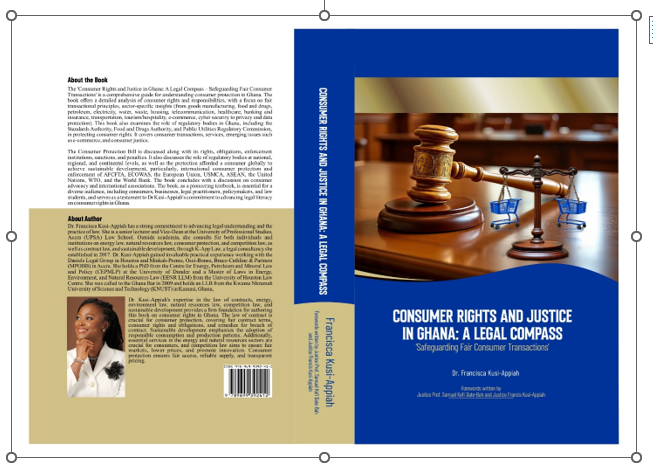
The book sets out a full analysis of the consumer protection system in Ghana. It addresses the sources of consumer protection law, the gaps in Ghana’s fragmented legal framework, and the risks consumers face in key sectors. The table of contents alone signals the scale of the work. It covers goods, food, pharmaceuticals, energy, water, waste, housing, telecommunication, healthcare, finance, transport, tourism, e-commerce, cybersecurity, enforcement, and international frameworks. The scope is significant. Few texts in Ghana have addressed consumer protection with this level of breadth and structure.
The introduction sets out the core problem. Ghana does not have a single, unified consumer protection law. The legal rules sit across scattered statutes. This fragmentation makes enforcement complex, slows regulatory action, and weakens consumer trust. Chapter 1 traces the history of consumer protection and explains who qualifies as a consumer. The book draws on common law cases such as Donoghue v Stevenson and Ghanaian cases such as Morkor v Kuma to show the evolution of consumer rights and duty of care obligations.
Chapter 2 provides a historical analysis of consumer protection in Ghana from independence to the Fourth Republic. It documents the roles of key institutions such as the Ghana Standards Authority (GSA), the Food and Drugs Authority (FDA), and the Public Utilities Regulatory Commission (PURC). The author explains how the absence of a dedicated consumer protection act has forced regulators to rely on sector-specific rules. She also highlights the role civil society has played in the absence of strong statutory protection. This includes CUTS International Accra, which the author recognises in the acknowledgements for its research and advocacy work on consumer rights.
The most valuable contribution of the book is the detailed sector-by-sector analysis. Chapter 3 covers manufactured goods, food, and pharmaceuticals. It outlines the consumer rights that arise in each sector and the enforcement mechanisms that support them. It reviews issues such as labelling, defects, counterfeit products, food safety, and drug regulation. Chapter 4 moves into public utilities. It explains consumer rights in electricity, water, waste management, housing, and telecommunication. The analysis is practical. It shows the links between regulatory failures and the daily struggles of Ghanaian consumers.
Chapter 5 shifts into health, banking, insurance, and transport. The sections on patient rights, fair lending, contract fairness in banking, and road safety show a clear commitment to real consumer problems faced by ordinary households. The discussion on road safety aligns with the broader national debate on making road crashes a public health issue. It draws attention to rights to information and rights against discrimination.
The chapter on emerging issues gives useful attention to digital markets. Chapter 6 examines e-commerce, mobile money, cybersecurity, privacy, and virtual currency. It explains the rising risk of fraud, data breaches, and unfair terms in online trade. The book draws on Ghana’s Electronic Transactions Act, the Data Protection Act, and the Cybersecurity Act. This section reflects current realities as more Ghanaians shift to digital platforms for goods and services.
Chapter 7 provides a thorough review of the Consumer Protection Bill, 2022. This section stands out as an important policy contribution. It outlines the rights proposed under the Bill, the duties of suppliers, the role of the Consumer Protection Authority, and the sanctions for violations. It shows why Ghana needs this Bill. Our fragmented legal framework makes enforcement weak. A consolidated law would align Ghana with global best practice and protect the market from unfair practices. The book makes a strong case for the Bill to be reintroduced and passed. Again, it also highlights the need for lawyers to become champions and advocates of consumer protection issues in the country.
The final chapter addresses international and regional consumer protection. It analyses frameworks under ECOWAS, AfCFTA, SADC, COMESA, the European Union, ASEAN and the United Nations. This comparative section strengthens the message that consumer protection is now a global governance issue. It shows how cross-border transactions, digital trade, and regional economic integration affect the Ghanaian consumer. The link to AfCFTA is useful. Ghana’s role as host of the AfCFTA Secretariat positions the country to lead on consumer-friendly trade rules across Africa.
Beyond the content, the book has strong practical value. It is not only a legal text. It is also a manual for businesses, consumers, regulators, and policymakers. It lays out clear rights, obligations, offences, and enforcement structures. It explains the limits of current laws and the risks of weak enforcement. It equips regulators and civil society with reference material. It gives students and researchers a structured framework for the study of consumer protection. It supports businesses that want to comply with standards. It provides consumers with accurate information about their rights.
This book fills a major gap. The author has produced a comprehensive resource for training, advocacy, and policy reform. Given our shared background and continued work in shaping consumer protection in Ghana, I see this book as an important milestone. It adds to the academic literature. It also serves as a practical guide for the marketplace. It strengthens the call for the passage of a strong consumer protection law.
I recommend this book to regulators, policymakers, legal practitioners, business leaders, and every student of consumer law. It brings clarity to a fragmented system. It provides structure for future reforms. It is an essential text for a country that aims to protect consumers and build fair markets.
- President Commissions 36.5 Million Dollars Hospital In The Tain District
- You Will Not Go Free For Killing An Hard Working MP – Akufo-Addo To MP’s Killer
- I Will Lead You To Victory – Ato Forson Assures NDC Supporters
Visit Our Social Media for More
About Author