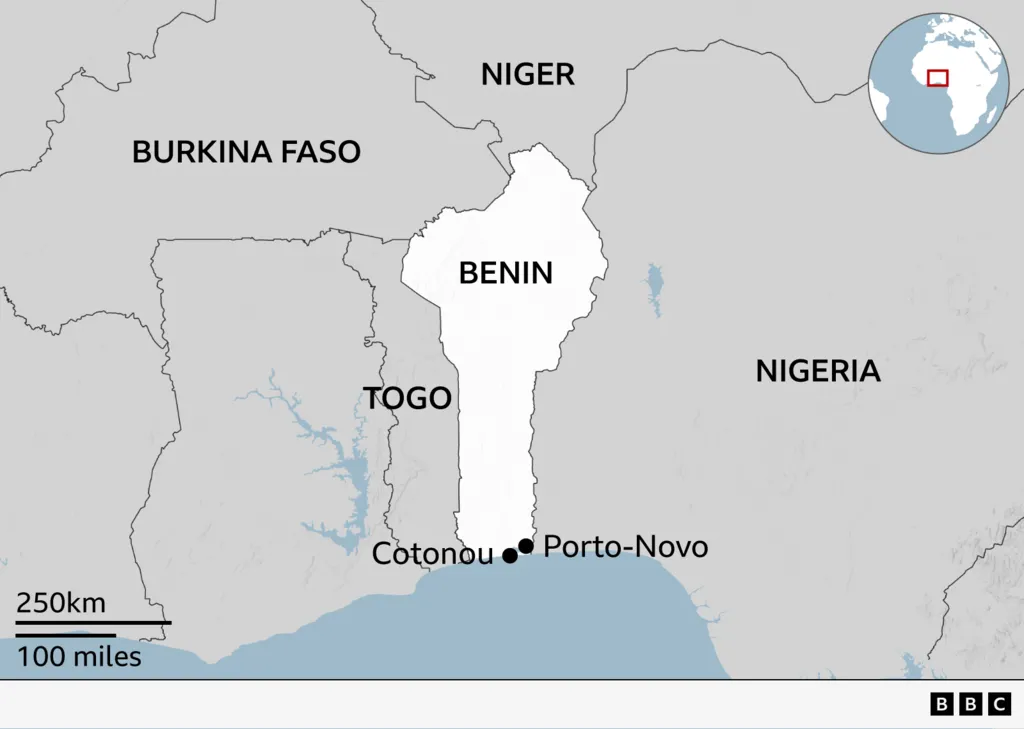
A senior government official in Benin has told the BBC that the leader of Sunday’s failed coup is taking refuge in neighbouring Togo.
Speaking on condition of anonymity, the official said that the government would request Lt Col Pascal Tigri’s extradition. Togo’s government has not yet commented.
The failed coup came after a series of military takeovers in West Africa, raising concern that democracy is increasingly under threat in the region.
It was thwarted after regional power Nigeria sent fighter jets to dislodge the mutineers from a military base and the offices of state TV following a request from President Patrice Talon’s government.
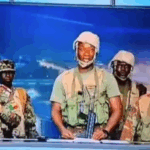
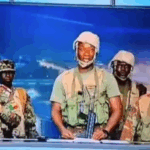
A group of soldiers appeared on state TV early on Sunday to announce they had seized power, and gunfire was heard near the presidential residence.
The Beninese government official said the authorities knew that Lt Col Pascal Tigri was in Togo’s capital, Lomé, in the same area where President Faure Gnassingbé lives.
“We don’t know how to explain this but we will make an official extradition request and see how the Togolese authorities will react,” the official added.
There is no independent confirmation of the claim.
Togo is part of the West African regional bloc, Ecowas, which condemned the coup attempt.
French special forces also helped loyalist troops to thwart the coup, the head of the Benin’s republican guard, which is in charge of protecting the president, told AFP news agency.
Dieudonne Djimon Tevoedjre said Benin’s troops were “truly valiant and faced the enemy all day” on Sunday.
“French special forces were sent from [Ivory Coast’s main city] Abidjan, used for mopping up operations after the Beninese army had done the job,” he was quoted as saying.
Benin’s government spokesman Wilfried Léandre Houngbédji could not confirm the deployment of French forces.
He told the BBC that as far as he knew, France had mainly provided intelligence support.
Ecowas has deployed troops from Nigeria, Ghana, Sierra Leone, and Ivory Coast to secure key installations in Benin.
The deployment signals that Ecowas is no longer willing to watch civilian governments fall without resistance.
Benin, a former French colony, has been regarded as one of Africa’s more stable democracies.
The nation is one of the continent’s largest cotton producers, but ranks among the world’s poorest countries.
Nigeria described the coup attempt as a “direct assault on democracy”.
Houngbédji told the BBC that a small number of soldiers from the National Guard were behind the coup attempt.
“The National Guard is a recent creation within our army, initiated by President Talon as part of our fight against terrorism. It is a land forces unit equipped with significant resources, following major investments in recent years, and its personnel are well trained,” he said.
Houngbédji added that Talon asked Ecowas to carry out airstrikes to neutralise the mutineers following indications that they had planned to attack the main airport in Cotonou, Benin’s largest city, putting at risk the lives of civilians living in the area.
“This led to the strategy of carrying out targeted airstrikes to immobilise their equipment, including the armored vehicles they threatened to use,” he said.
The rebel soldiers justified their actions by criticising Talon’s management of the country, complaining first about his handling of the “continuing deterioration of the security situation in northern Benin”.
Benin’s army has suffered losses near its northern border with insurgency-hit Niger and Burkina Faso in recent years, as jihadist militants linked to Islamic State and al-Qaeda spread southwards.
The soldiers’ statement cited “the ignorance and neglect of the situation of our brothers in arms who have fallen at the front and, above all, that of their families, abandoned to their sad fate by Mr Patrice Talon’s policies”.
The rebels also hit out at cuts in health care, including the cancellation of state-funded kidney dialysis, and taxes rises, as well as curbs on political activities.
Talon, who is regarded as a close ally of the West, is due to step down next year after completing his second term in office, with elections scheduled for April.
A businessman known as the “king of cotton”, he first came to power in 2016. He has endorsed Finance Minister Romuald Wadagni as his successor.
Talon has been praised by his supporters for overseeing economic development, but his government has also been criticised for suppressing dissenting voices.
In October, Benin’s electoral commission barred the main opposition candidate from contesting the election.
The attempted coup came just over a week after Guinea-Bissau’s President Umaro Sissoco Embaló was overthrown – though some regional figures have questioned whether this was staged.
In recent years, West Africa has also seen coups in Burkina Faso, Guinea, Mali and Niger, prompting concerns about the region’s stability.
Russia has strengthened its ties with these Sahel countries over recent years – and Burkina Faso, Mali and Niger have left the West African regional bloc Ecowas to form their own group, the Alliance of Sahel States.
News of the attempted takeover in Benin was hailed by several pro-Russian social media accounts, according to BBC Monitoring.
- President Commissions 36.5 Million Dollars Hospital In The Tain District
- You Will Not Go Free For Killing An Hard Working MP – Akufo-Addo To MP’s Killer
- I Will Lead You To Victory – Ato Forson Assures NDC Supporters
Visit Our Social Media for More
About Author