Africa is on a fierce campaign that, if successful, will see the Mercator map replaced with the
Equal Earth map on web-based platforms, mobile apps, desktop software, and embedded
systems for our home planet, Earth.
Most web-based platforms, including Google Maps, Apple Maps, and Bing Maps, still use the 16th-century Mercator projection for their maps.
The Mercator map, created in 1569 by Flemish cartographer Gerardus Mercator, was purposefully
designed to facilitate navigation. Over time, however, it has been used in many other fields far
beyond its original intent.
Even though this map maintains the angles and directions between geographic locations, it
shrinks the actual size of continents near the equator (e.g., Africa, South America) while
exaggerating areas near the poles (e.g., North America, Greenland).
This distortion does not sit well with two African civil society organisations, Africa No Filter and
Speak Up Africa, which is urging policymakers, educational institutions, and media platforms to
“stop using distorted projections” and promote a more accurate world map.
Their campaign, with the heartbeat slogan #CorrectTheMap, caught the attention of the African
Union (AU), which has since backed the move.
“It might seem to be just a map, but in reality, it is not,” said AU Deputy Chairperson Selma Malika Haddadi.
Supporters of the campaign argue that replacing the Mercator map is a matter of correcting a
historical visual injustice that has perpetuated colonial legacies and skewed perceptions of the
continent’s importance.
The core of their argument is now the subject of a petition awaiting determination at the United
Nations Global Geospatial Information Management (UN-GGIM) body.
In the meantime, this scientific piece seeks to show the scorecard of the ‘fight’ to replace the
Mercator map with the Equal Earth map; the significance of projections in mapping; the
successes, the politics, and what lies ahead.
Mapping a polar-flattened sphere on paper: the Science of Projection
Our planet Earth, the third rocky planet after Mercury and Venus, respectively, in the solar system,
is not a perfect sphere but rather slightly flattened at both the northern and southern poles.
As a result, mapping such a polar-flattened sphere onto a flat surface demands some key
compromises.
Generally, a map is a symbolic representation of selected characteristics of a place, usually
drawn on a flat surface. Maps teach about the world by showing the sizes and shapes of
countries, the locations of features, and the distances between places.
Replacing Mercator with Equal-Earth: 456 years of cartographic distortion of Africa and Greenland
Transferring information from the spherical, or ball-shaped, surface of Earth onto a flat piece of
paper is called projection. Projection is a major challenge for mapmakers (cartographers), and
every map has some sort of distortion.
Trying to project Earth’s surface onto a flat plane is like trying to flatten an orange peel without
tearing or stretching it. In other words, transferring a three-dimensional (3D) sphere onto a two-dimensional (2D) paper will inevitably introduce distortion.
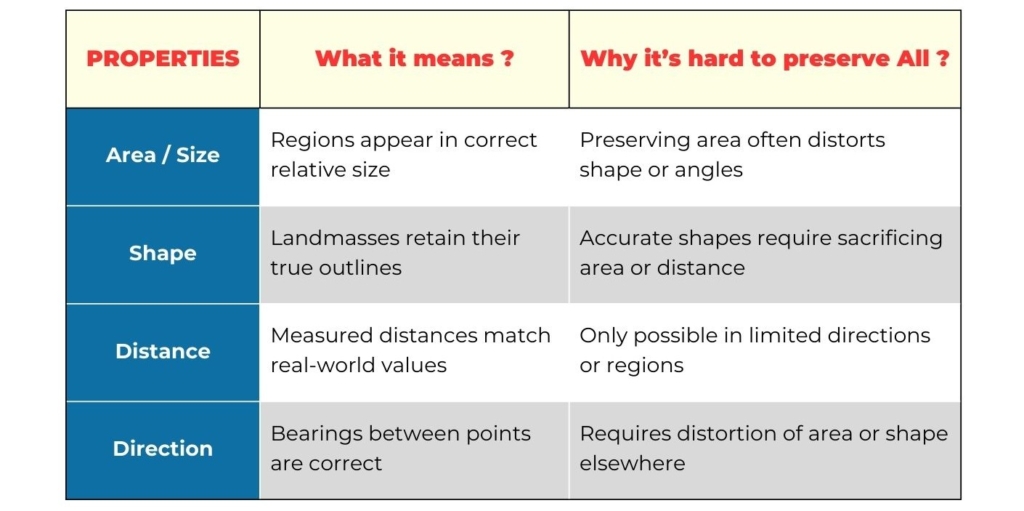
You can’t mathematically preserve all geographic properties at once. Every projection must
compromise between four key properties: Area/size, shape, distance and direction.
Table 1:
The reason all four properties cannot be preserved in a single projection is formalised in Gauss’s
Theorema Egregium. It proves that you cannot map a curved surface to a flat one without
distortion.
Gauss’s theorem shows that the curvature of a surface is intrinsic and can be measured using
only distances and angles on the surface, without needing to view it from outside.
This means you can’t flatten a curved surface like a sphere onto a plane without distortion, because their
curvatures are fundamentally different.
Mathematically, the Gaussian curvature (K) is computed from the surface’s first and second
fundamental forms.
The formula proves that curvature depends only on the surface’s internal geometry, not its shape in space.
Therefore, every flat map of the Earth must distort something, either area, shape, distance, or
direction, simply because it’s impossible to preserve all four simultaneously.
Figure 1:
Map projections: The elephant in the room
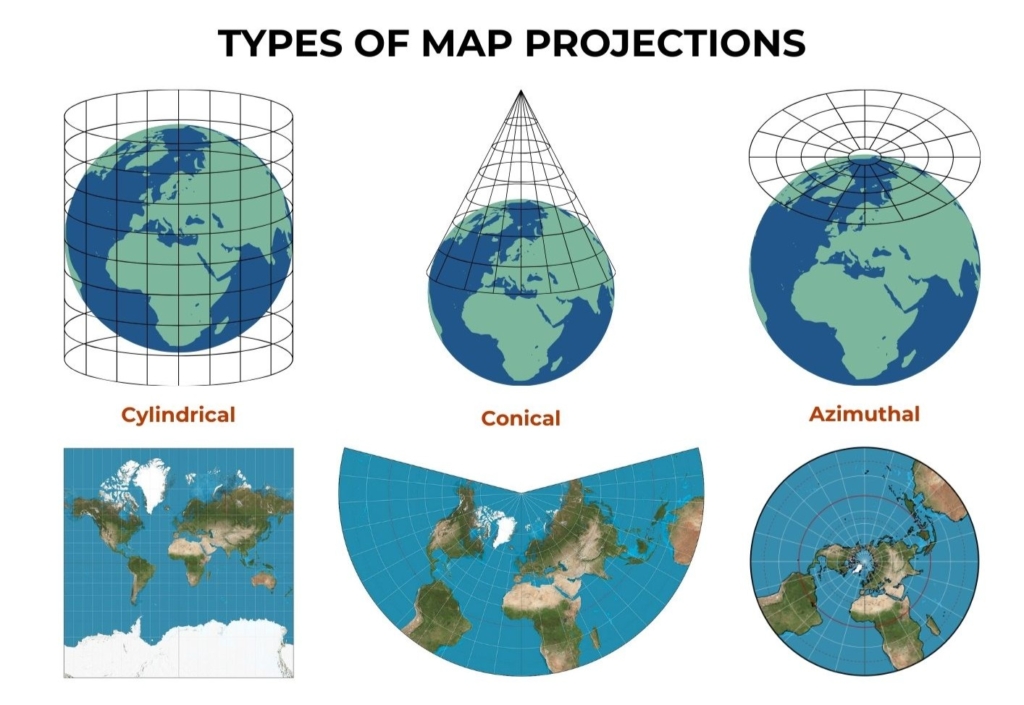
There are hundreds of map projections that can be succinctly summarised into three major types:
Cylindrical, Conical, and Azimuthal map projections.
The Mercator map of the Earth was made using the cylindrical projection and is well known for its
distortion near the polar regions.
Figure 1 illustrates how each of these projection types differs from the others.
Cylindrical projections wrap the globe as if around a cylinder, conical projections use a cone, and azimuthal projections flatten from a single point, each with its own trade-offs in distortion.
Figure 2:
The Mercator Projection: Navigation’s gift, Geography’s curse
The Mercator projection, now 456 years old, remains one of the most recognisable world maps.
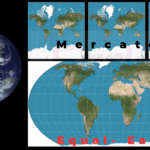
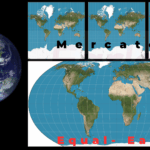
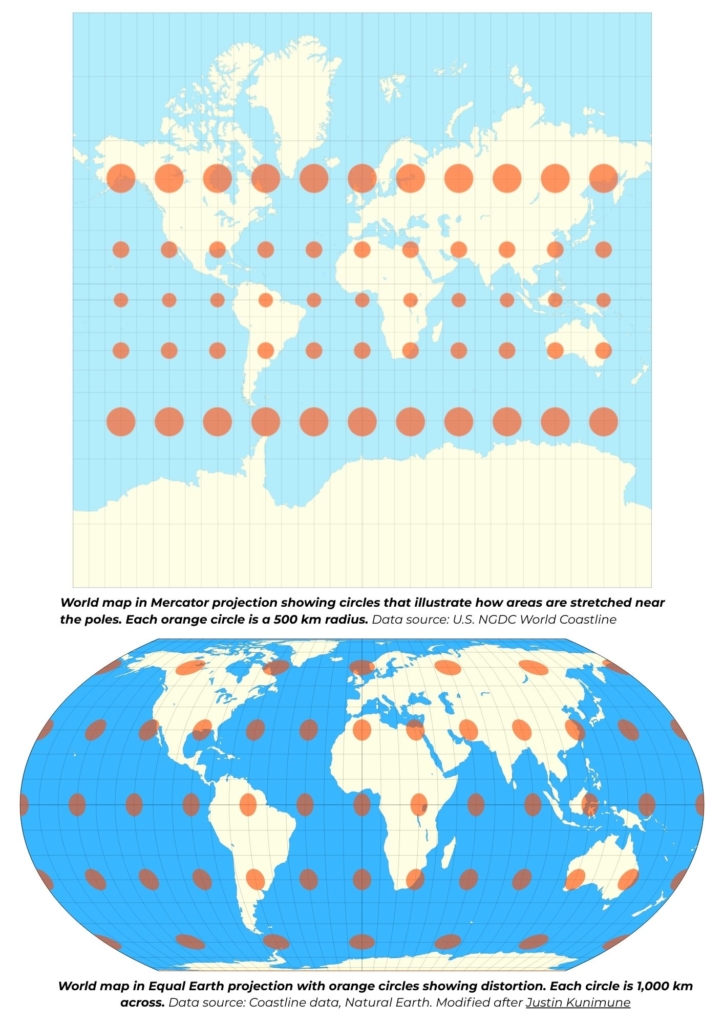
The top panel in Figure 2 shows the Mercator map with orange circles aligned along lines of latitude and longitude.
The size of these circles increases toward the poles while remaining smaller near
the equator.
Clearly, regions closer to the poles appear much larger than they actually are. For instance,
Greenland and Antarctica look disproportionately large compared to equatorial regions like
Africa.
In reality, Greenland has a total area of 2,166,086 km², while Africa, the world’s second-largest
continent covers 30,365,000 km², making Africa fourteen times bigger than Greenland.
Yet, these surfaces are not accurately represented on the Mercator projection.
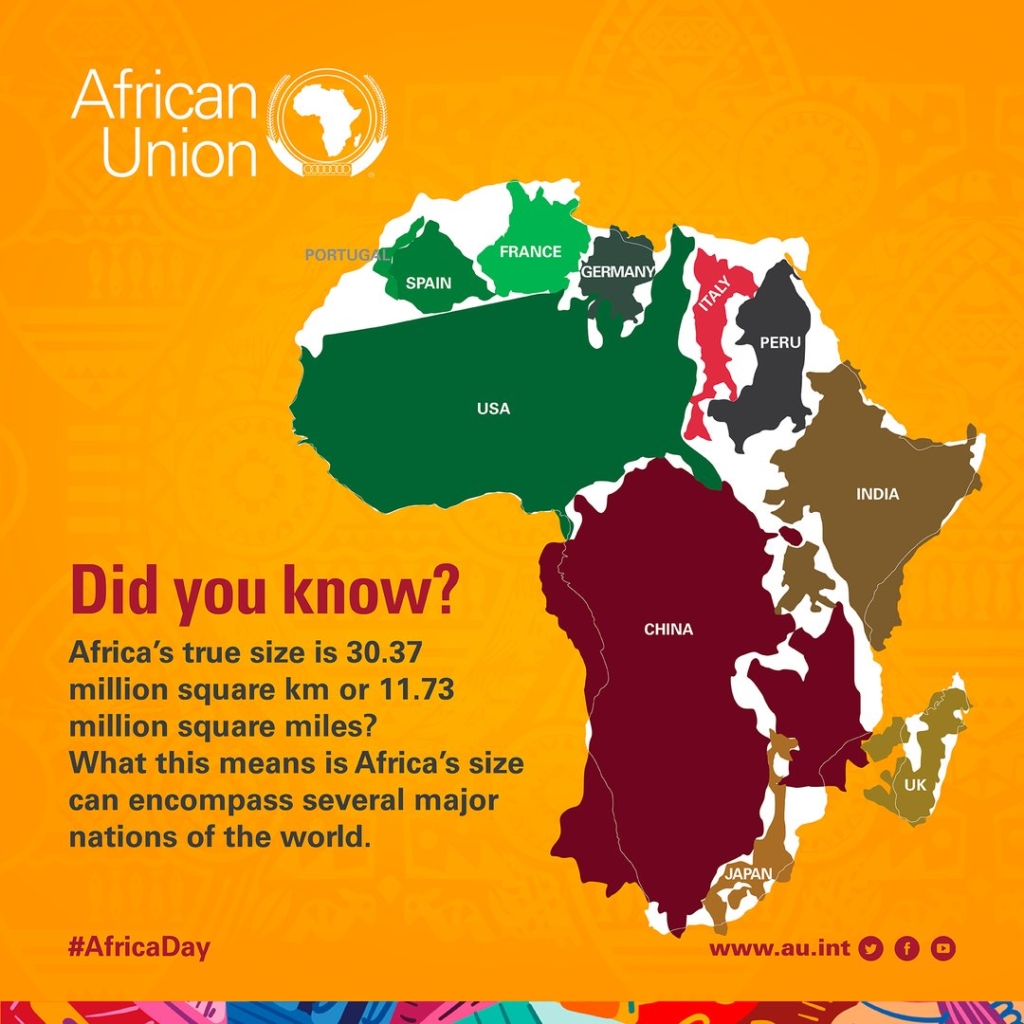
To highlight Africa’s true size, the African Union recently shared a map of Africa with the outlines
of eleven (11) major countries drawn inside it for scale, including the United States, United
Kingdom: Germany, France, Japan, Italy, Spain, Portugal, China, Peru, and India.
This visual reminder underscores how Mercator’s legacy continues to shape global perception.
Figure 3:
The Rise of the Equal-Earth Projection
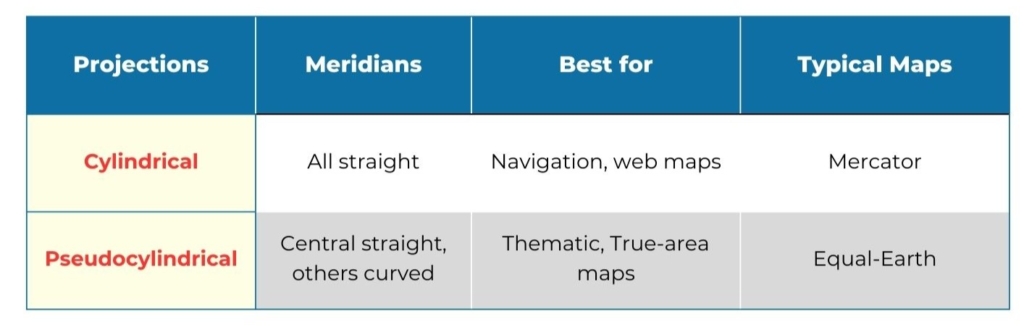
The Equal-Earth map projection is an equal-area pseudocylindrical global map projection. It was
invented by Bojan Šavrič, Bernhard Jenny, and Tom Patterson in 2018 to better reflect the true
proportions of continents while maintaining a visually appealing shape (bottom panel, Figure 2).
The curved sides of this projection suggest the spherical form of Earth.
The central meridian is straight, while others are curved to better balance distortion. The parallels are straight, making it easy to compare how far north or south places are from the equator.
Unlike the Mercator projection, Equal Earth ensures that each region’s relative area is preserved,
offering both fairness and realism.
Table 2:
The Gains thus far: NASA and the World Bank lead the way
Palpable evidence of the #CorrectTheMap campaign’s impact has been seen on two major fronts:
The National Aeronautics and Space Administration (NASA) and the World Bank.
NASA’s Goddard Institute for Space Studies (GISS) adopted the Equal-Earth projection in 2018 for
its global climate anomaly maps, prioritising area accuracy and visual equity.
The World Bank followed suit in 2019, gradually integrating Equal Earth into its thematic
cartography to better represent development data across regions.
These early adoptions mark a slow but significant shift toward a more balanced worldview,
literally and metaphorically.
The political ghost in Mapping
In his August 2020 article “The Map Is Never Neutral,” Walker D. Mills argues that maps are often
“political arguments,” and therefore, strategists must learn to interpret them as such.
He illustrates this point with several examples: Morocco has used maps to dispute its border with
Algeria and justify its effective annexation of Western Sahara (Zunes & Mundy, 2010).
Similarly, Guatemala refuses to recognise its boundary with Belize, while Argentina continues to claim the
Falkland Islands, known locally as the Islas Malvinas, on its national maps (Neuman, 2012).
Mills’ observations echo those of Hartley, who noted that “as much as guns and warships, maps
have been weapons of imperialism… used to legitimise the reality of conquest and empire.”
Maps have always carried political weight, and nowhere is this more evident today than in
debates over whether or not the ongoing Russia–Ukraine war could lead to a redrawing of
Ukraine’s borders.
As the conflict continues to reshape geopolitical realities, it raises the difficult question of who ultimately gets to decide how a nation is mapped.
These perspectives, among others, underscore the historical and ongoing use of cartography as
a means of control and persuasion. With the rise of digital mapping technologies, the potential
for maps to shape political narratives and even deceive has only intensified.
It is therefore not far-fetched to argue that the persistent use of the Mercator projection carries a
subtle layer of political undertone, one that continues to reinforce historical hierarchies of power
and perception.
Changing to a true view of our planet, Earth
As the world awaits the opinion and directive from the United Nations Global Geospatial
Information Management (UN-GGIM), it would be precipitous to conclude that the Mercator map
has outlived its purpose.
The Mercator retains its usefulness in the world of sea navigation, the purpose for which it was
made. However, after more than four and a half centuries of use, it behoves the world to embrace
change.
A change to the Equal Earth projection, one that maps the continents and countries of our planet
respecting their true sizes.
A more accurate change, as in the eye of a bird flying over these vast landmasses.
A change to an Equal Earth map that is more just, devoid of historical visual injustice.
A change that presents a world map to a young girl in New Cairo City from a neutral and educational point of view.
A change that reassures a primary school boy in Ho, Volta Region, that a map of Africa made in
Ghana is the same as that used by a teacher in Greenland.
A change that reflects how much knowledge we have acquired over these past 456 years of mapping, how much data we have collected from numerous satellites and through space missions.
A change that resonates with our present realities.
The writer, Eli Djomekou is a Science Communicator and Graduate in Earth and Planetary
Sciences.
- President Commissions 36.5 Million Dollars Hospital In The Tain District
- You Will Not Go Free For Killing An Hard Working MP – Akufo-Addo To MP’s Killer
- I Will Lead You To Victory – Ato Forson Assures NDC Supporters
Visit Our Social Media for More
About Author