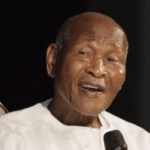
Former president of the Ghana Bar Association, Sam Okudzeto, says corruption remains widespread in Ghana because the Office of the Special Prosecutor (OSP) has failed to achieve the purpose for which it was created.
He believes the institution has missed its mission and should never have existed in the first place.
Speaking on Joy News’ PM Express on December 8, Mr Okudzeto said the country continues to see blatant acts of corruption in public institutions, making it clear that the OSP has not changed anything.
He argued that the office has not delivered the results Ghanaians expected when it was established.
“Sometimes someone says it is not what you think you are entitled to, but it is what you can give. But it should be. So you’re asking me this question. The question is simply this: why was the institution set up? Has it achieved its purpose?” he asked.
Host Evans Mensah pushed further: “Has it? What would you say?”
“I don’t think so. That is exactly the issue that I’m trying to drive here. It hasn’t achieved its purpose, because the corruption is still on. I see it every day. Everywhere you turn in every institution, you see it openly.
“They are not even afraid. People are no longer even afraid. You go there, and they demand money from you to do this for you when you already paid,” he said.
Asked whether scrapping the OSP would solve the problem, Mr Okudzeto insisted the office simply duplicates the mandate of existing state institutions and was unnecessary from the start.
“Yeah, I’m saying that that institution is not achieving its purpose. Because look at it this way, you have an Attorney-General’s Department. Is that not correct? Yes. In that department, they have a civil section, and then they have a prosecutorial section. This one is headed by the Director of Public Prosecutions.
“The other one is headed by the Solicitor General. Now, what is the Director of Public Prosecutions supposed to do? He’s supposed to prosecute criminal offences which will include corruption and corruption-related.
“There is nothing which makes corruption any more different than any other crime. We have a Director of Public Prosecutions. That is his job. Why do you create another institution to do the same job? That’s the whole issue.”
Evans Mensah noted that the OSP was meant to be a special-purpose vehicle to deal only with corruption-related offences.
But Mr Okudzeto rejected that argument. He said countries that adopt a special prosecutor typically appoint one to tackle a specific problem, not build an entire institution around the role.
According to him, Ghana’s decision to treat the position as a standalone office was misguided.
“You see, in other places where you have this special prosecutor, it means that there is a specific problem that has arisen, and you want that person to go there and solve that problem. You don’t create the whole institution for it, as we have done.
“If you like, you can go and search and ask where and where do we have that kind of institution? You see, the Prime Minister of England, you know what his position was before? You know how he got the knighthood? He was the Director of Public Prosecutions. Justice D. F. Anang, who became the Speaker of Parliament, was also Director of Public Prosecutions,” he said.
Asked whether he agrees with those calling for the OSP to be scrapped and the Attorney-General’s Department strengthened instead, he responded without hesitation.
“That is what should have been done. But I suspect that somebody thought that corruption was too rampant in the country, and, therefore, to create an institution for that purpose was a good idea. And then, of course, you appoint an individual. Don’t forget, it’s just an individual you’ve appointed.
“Then you are now trying to create an institution around that individual. What is the background of that? That’s the question I ask. What is his background of that individual? If I am going to try and select one of the top legal luminaries and say that I’m giving him that, that’s a different thing.”
He warned that building institutions around individuals without properly preparing them for the job is dangerous.
“I’m just saying that when you don’t train people to do a job, you think that creating institutions, particularly when they think it’s just an individual, it’s dangerous. It’s very, very dangerous,” he said.
- President Commissions 36.5 Million Dollars Hospital In The Tain District
- You Will Not Go Free For Killing An Hard Working MP – Akufo-Addo To MP’s Killer
- I Will Lead You To Victory – Ato Forson Assures NDC Supporters
Visit Our Social Media for More
About Author